Finding the best durable rubber dog toys for aggressive chewers usually means going through a few “indestructible” ones that didn’t live up to the name first. Most rubber toys don’t fail because of a bad brand — they fail because the hardness, shape, or material was never right for that dog’s bite in the first place. A toy built for a lighter chewer usually won’t hold up once a dog starts biting down with real force. Below is what actually predicts whether a rubber toy survives, followed by three picks to consider, including a clear-eyed look at which one isn’t the right call for your hardest chewer.
What Actually Makes a Rubber Toy Aggressive-Chewer-Ready
“Aggressive chewing” isn’t one single behavior — it covers everything from a dog that gnaws steadily for twenty minutes to one that treats a toy like a demolition project the second it’s handed over. Because of that range, no single spec tells you whether a rubber toy will hold up. Durability comes down to three things working together: how hard or soft the rubber is, what shape the toy is molded into, and what the rubber is actually made from.
A toy can score well on one of these and still fail. A hard rubber ball can still get chewed apart if it’s shaped with thin ridges or hollow sections that give a determined dog something to grab onto. A simple, solid shape can still wear down fast if it’s made from a material meant for light chewing. That’s part of why toys marketed as “tough” or “heavy duty” sometimes get destroyed anyway — the marketing is describing one property, not the combination that actually determines whether the thing survives.
Nothing here is dog-proof against every bite force out there — a smaller dog with a moderate chew and a large, powerful chewer can wear down the very same toy at completely different speeds. The sections below walk through how to check hardness and shape for yourself, so you’re not relying on a label to make that call for you.
The Hardness Test That Actually Predicts Durability
Press your thumbnail into the rubber. If it leaves almost no mark and springs back instantly, the rubber is on the harder end and better suited to a strong chewer. If your nail sinks in easily, that toy is built more for a light or moderate chewer, not one that bites down hard.
That simple test is a stand-in for something rubber manufacturers actually measure: Shore hardness, usually written as a number followed by “A” (like 60A). It’s a scale that measures how much a material resists being indented — higher numbers mean firmer rubber, lower numbers mean softer. For context, a rubber toy built for gentle, puppy-level chewing typically sits around 55A to 60A on that scale, soft enough to flex under light pressure but not built for repeated hard bites. Toys made for aggressive chewers use denser, higher-hardness rubber that resists that same pressure.
There’s a second test worth knowing: press the toy against your kneecap as hard as you comfortably can. If it hurts, the rubber is dense enough to stand up to serious bite force. If it flexes and gives easily, a strong chewer will probably work through it faster than a lighter one would.

Natural Rubber vs. TPR: What the Difference Actually Means for Your Dog
Not all “rubber” dog toys use the same material. Natural rubber comes from vulcanized latex — rubber that’s been treated with heat and sulfur to make it firmer and more elastic. It tends to be denser and more resistant to tearing, which is why it shows up in toys built specifically for stronger chewers.
TPR, or thermoplastic rubber, is a different category. It’s a blend of rubber and plastic, molded to feel rubbery and flexible while being cheaper and easier to shape into detailed textures — things like dental ridges, bone shapes, or squeaker chambers. That flexibility is exactly why TPR gets used so often in dental-chew and puppy toys: it’s gentle enough for developing teeth and gums.
The tradeoff shows up with harder chewers. Looking across several TPR toys’ own product listings, a consistent pattern shows up: they’re described as working best for light-to-moderate chewing, not as heavy-duty toys for genuinely aggressive chewers. That’s not a flaw in TPR — it’s just not the material built for that job. If your dog is a puppy, an older dog with a gentler bite, or mainly wants a dental-texture toy to gnaw on between meals, TPR is a reasonable and often more affordable choice. When a dog reliably destroys “tough” toys within days, natural or vulcanized rubber is the material to look for instead.
Rubber Toys That Are Actually Built for Aggressive Chewers (And Who Each One Isn’t For)
These three come closest to being the best durable rubber dog toys for aggressive chewers in our current lineup, though one of them comes with a real caveat before you buy.
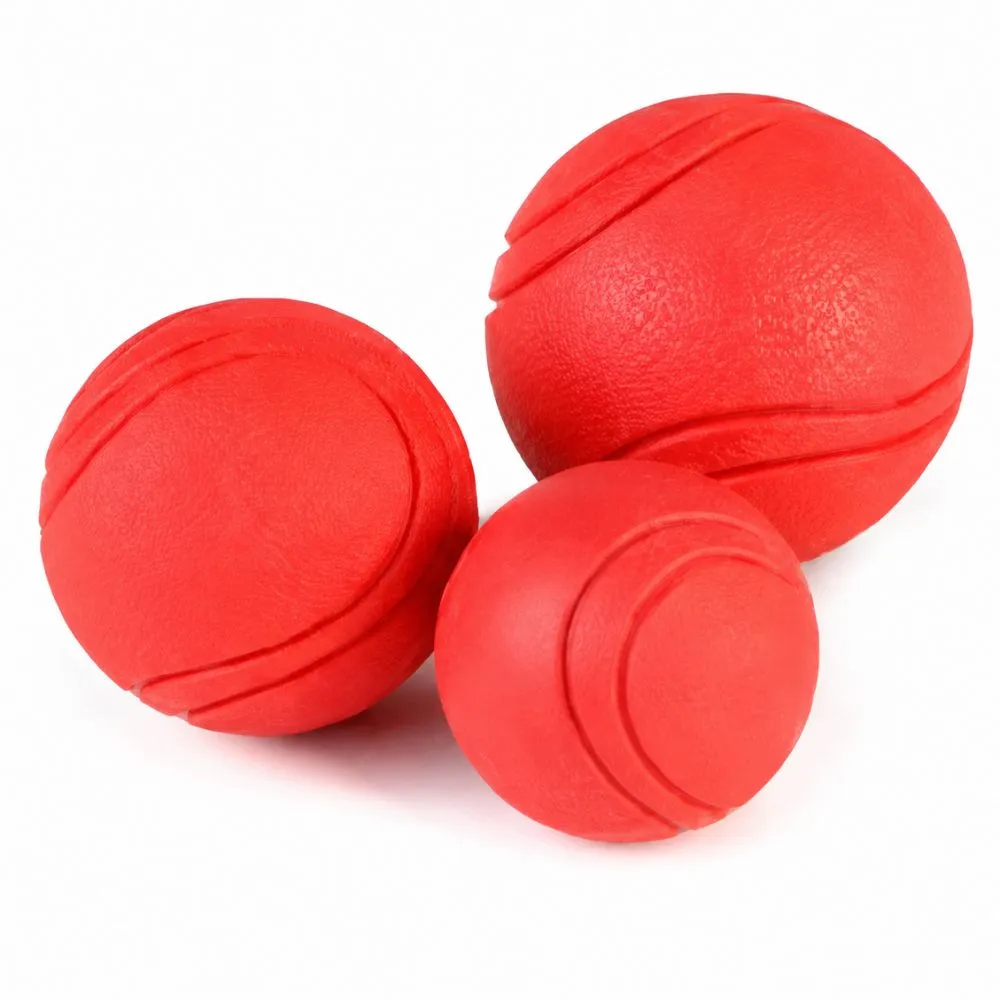
Our solid rubber chew ball is the most straightforward pick here, since it’s built and sized specifically for this use case with no real caveat attached. It runs from about 5cm (roughly 70g) for smaller dogs up to 7cm (about 180g) for large breeds like Rottweilers, German Shepherds, and Pitbulls, so it’s sized to match the dog rather than being a one-size-fits-all ball that’s too small for a big dog’s bite force.
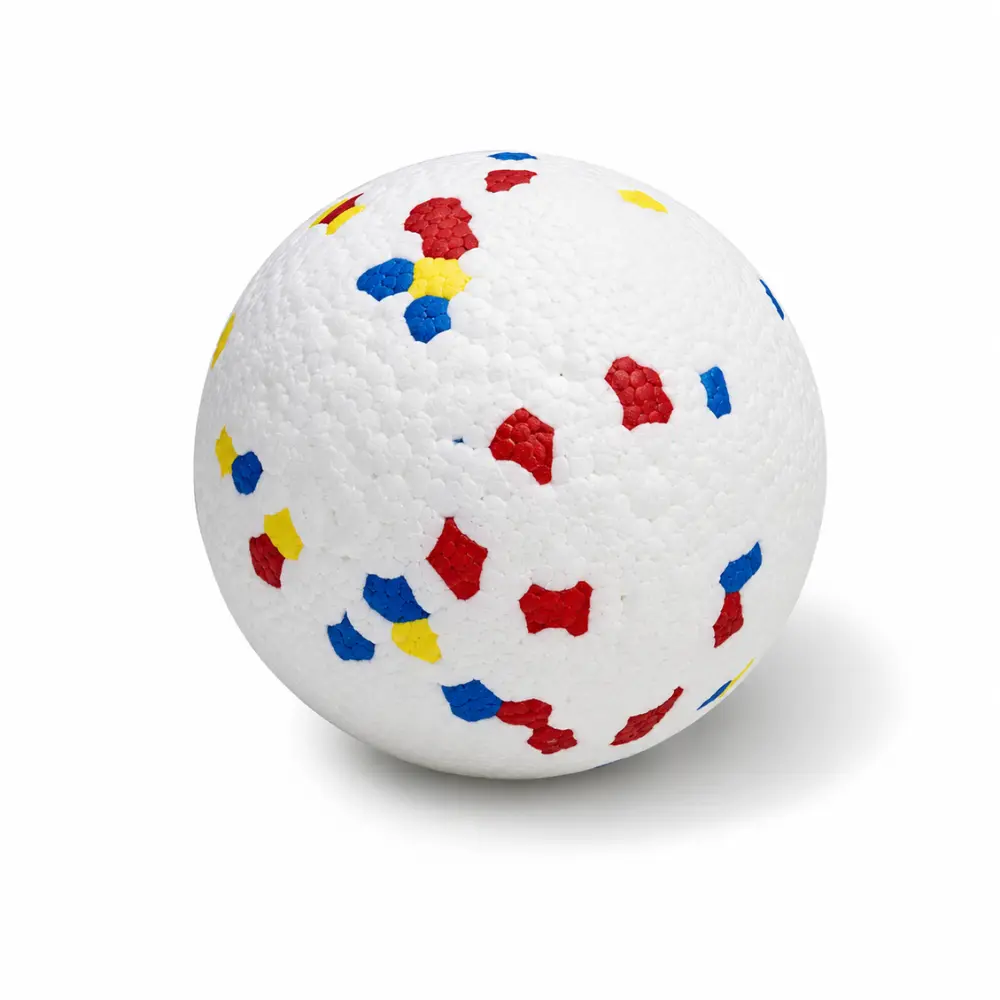
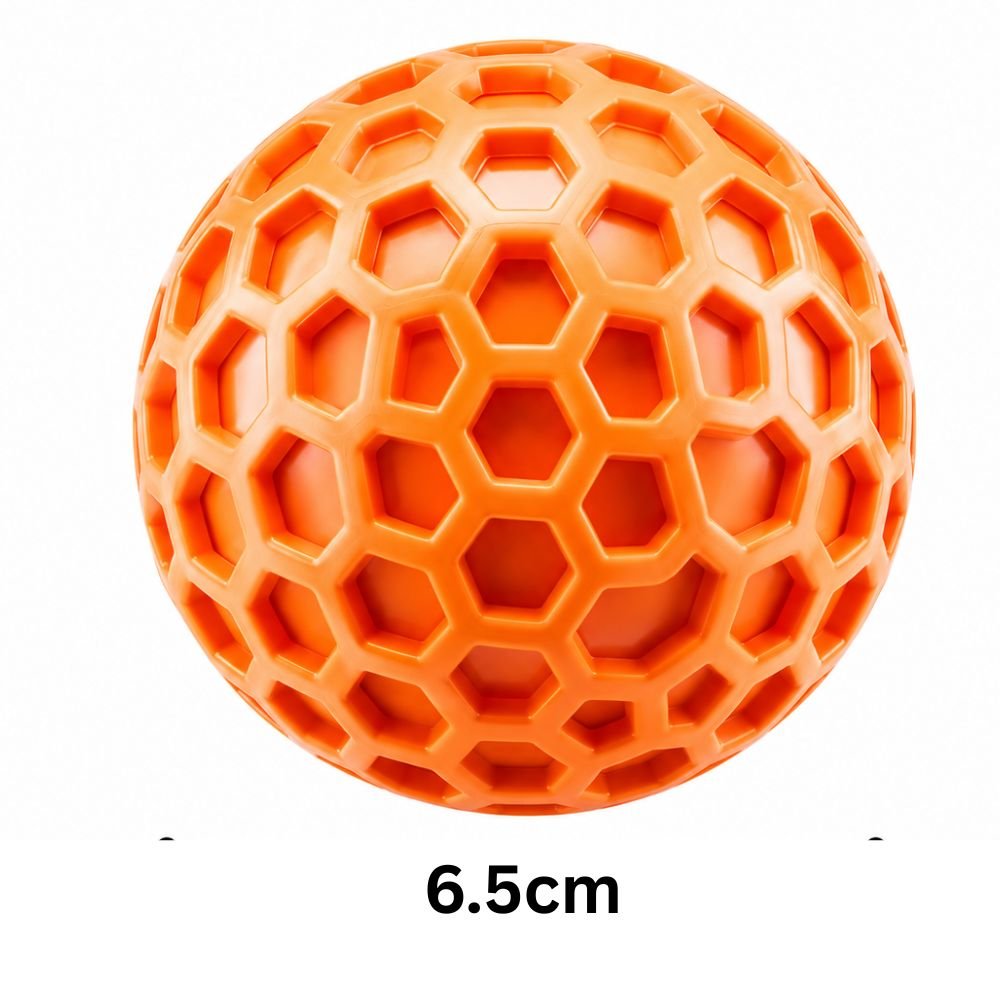
If your dog also loves fetch or water play, this bite-resistant elastic ball deserves a look. It’s molded as a solid piece of elastic rubber rather than a hollow shell, and that construction is what lets it hold up to repeated hard bites better than a hollow bounce ball would. It comes in two sizes, a 2-inch (5cm) ball weighing about 1.1 oz (31g) and a 2.4-inch (6cm) ball weighing about 1.8 oz (52g), and it’s listed as suitable for small, medium, and large breeds as well as puppies. It floats and bounces, so it doubles as a fetch-and-swim toy on top of being something to chew on at home.
Signs a Rubber Toy Has Reached the End of Its Life
Even a well-built rubber toy won’t last forever, and there’s no fixed timeline to watch for — how long one lasts depends entirely on your dog. What matters more is knowing what to look for.
Take a toy out of rotation if you notice any of these:
- Visible cracks or splits in the rubber, even small ones
- Chunks missing or bitten off
- Soft, mushy, or gouged spots where the surface used to be firm
- Any point where the inner material is exposed
A crack or a soft spot might seem minor, but it’s usually the start of a bigger piece breaking off, and that’s the kind of piece a dog can swallow. If you notice any of the signs above, it’s worth pulling the toy from rotation right away rather than waiting to see how much worse it gets. Slower, more gradual wear, like dulling color or minor surface scuffing, is usually fine to keep monitoring rather than needing an immediate swap.