
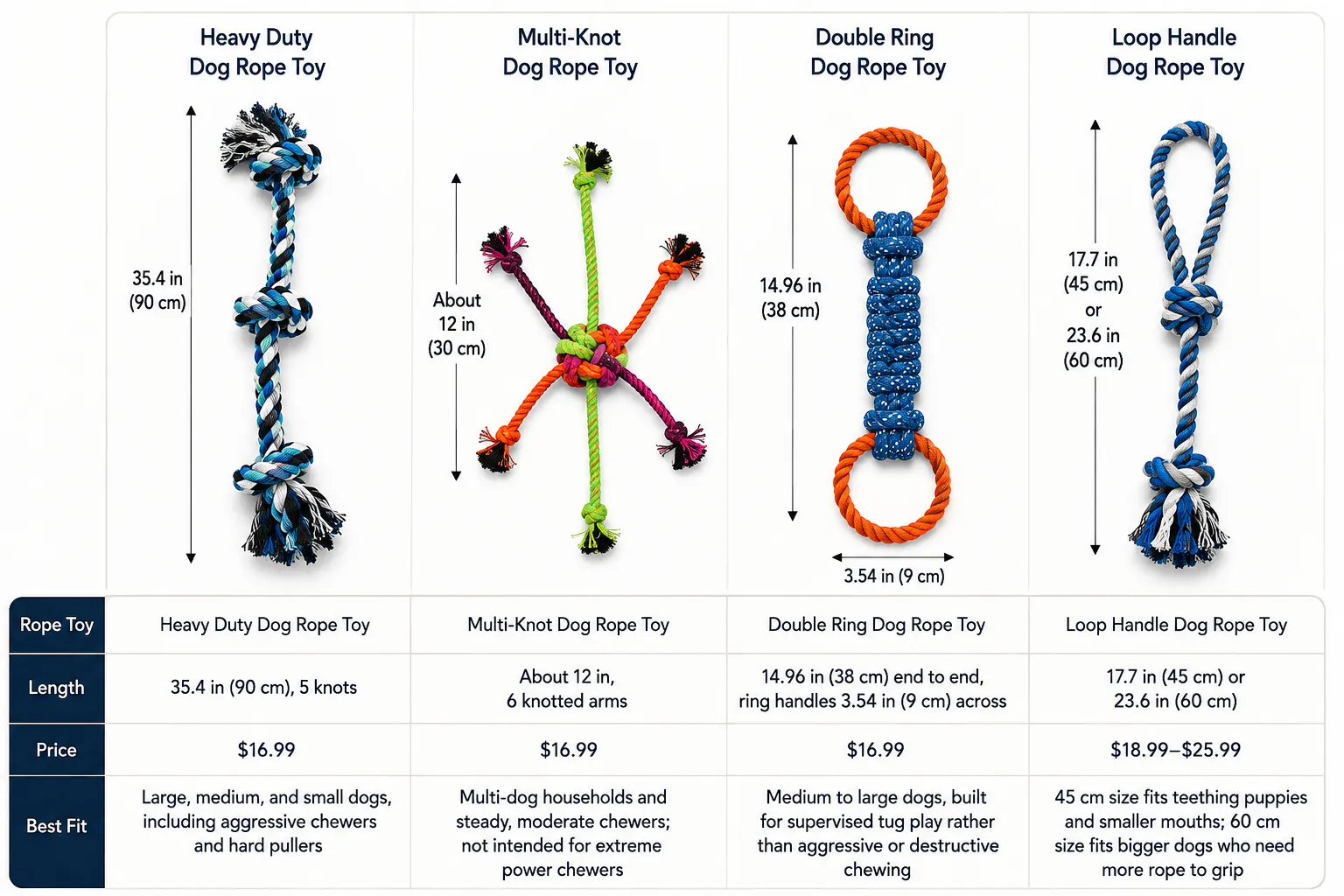
Here’s how our current rope toy lineup breaks down by length and best fit:
| Rope Toy | Length | Price | Best Fit |
|---|---|---|---|
| Heavy Duty Dog Rope Toy | 35.4 in (90 cm), 5 knots | $16.99 | Large, medium, and small dogs, including aggressive chewers and hard pullers |
| Multi-Knot Dog Rope Toy | About 12 in, 6 knotted arms | $16.99 | Multi-dog households and steady, moderate chewers; not intended for extreme power chewers |
| Double Ring Dog Rope Toy | 14.96 in (38 cm) end to end, ring handles 3.54 in (9 cm) across | $16.99 | Medium to large dogs, built for supervised tug play rather than aggressive or destructive chewing |
| Loop Handle Dog Rope Toy | 17.7 in (45 cm) or 23.6 in (60 cm) | $18.99–$25.99 | 45 cm size fits teething puppies and smaller mouths; 60 cm size fits bigger dogs who need more rope to grip |
As a general guide, if your dog is a confirmed heavy chewer or a strong puller, it’s safer to size up than down. A rope that feels slightly long for your dog’s current size will hold up better than one sized exactly to today’s measurements, especially if your dog is still growing. If your dog falls firmly into the hard-puller category, our Heavy Duty Dog Rope Toy’s extra length is built around exactly that need.
That’s part of why our Loop Handle Dog Rope Toy comes in two lengths — it’s easier to move up a size as your dog grows into a bigger chewer, rather than replacing the whole toy. The two ring handles on our Double Ring Dog Rope Toy give both a person and a dog — or two dogs playing together — a solid, comfortable grip point on either end.
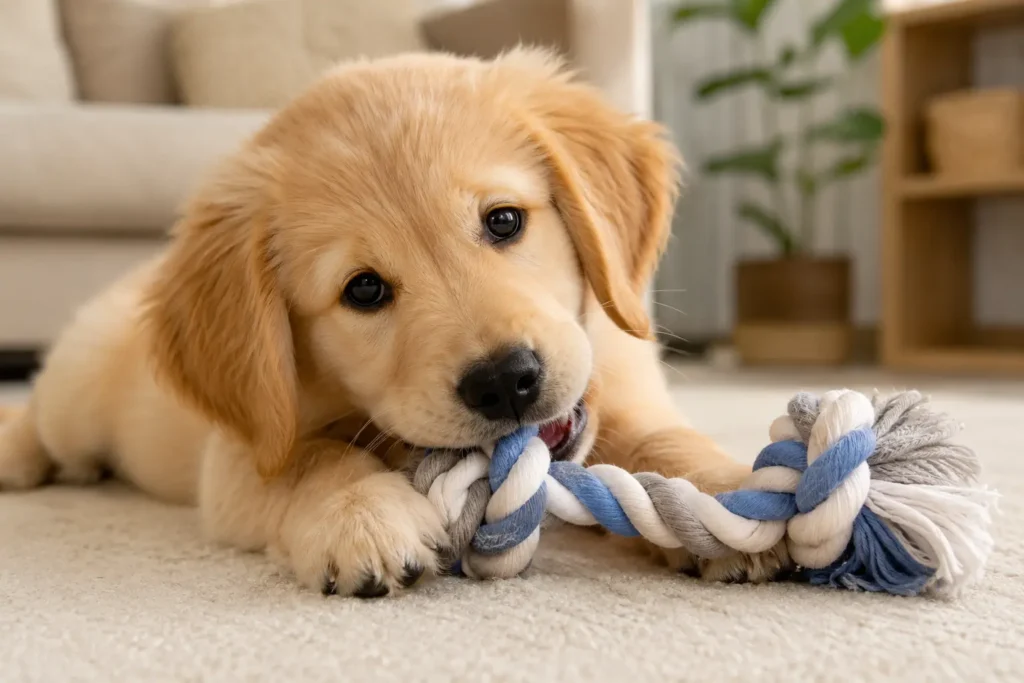
If your dog is still working up to full size, keep in mind that a toy built for an adult’s bite is often too much rope for a puppy’s smaller mouth and softer teeth. Our guide to rope toys for puppies covers what to look for at that stage instead.
Not sure which one fits your dog? Browse the full lineup in our Dog Rope Toys collection and filter by size
Rope Toy vs. Chew Toy — Why the Distinction Matters for Big Dogs
A rope toy and a chew toy solve two different problems, even though they can look similar sitting in a toy bin. A chew toy is built to survive a dog gnawing on it alone, for long stretches, without anyone watching. A rope toy is built for interactive play — tug-of-war, fetch, carrying it around — with a person or another dog involved, ideally with some supervision.
That difference matters more for large dogs than small ones. A big dog left alone with a rope toy for hours can work through its fibers a lot faster than a small dog would, simply because there’s more bite force behind every chew. Treating a rope toy like an unsupervised chew toy is one of the most common ways a durable-looking rope ends up fraying faster than expected
If your dog is more of a solo, all-day chewer than a tug-and-play dog, a solid rubber or nylon chew toy is usually the better fit for those unsupervised stretches, with the rope toy reserved for the times you’re actually there to play. It’s not that rope toys are the wrong choice — it’s that they’re the right choice for a specific kind of play, not a stand-in for every kind of chewing. Our Double Ring Dog Rope Toy is a good example of a toy built with that boundary in mind — designed for interactive tug sessions, not as something to hand over and walk away from.
Tug-of-War Safety with Strong, Large Dogs
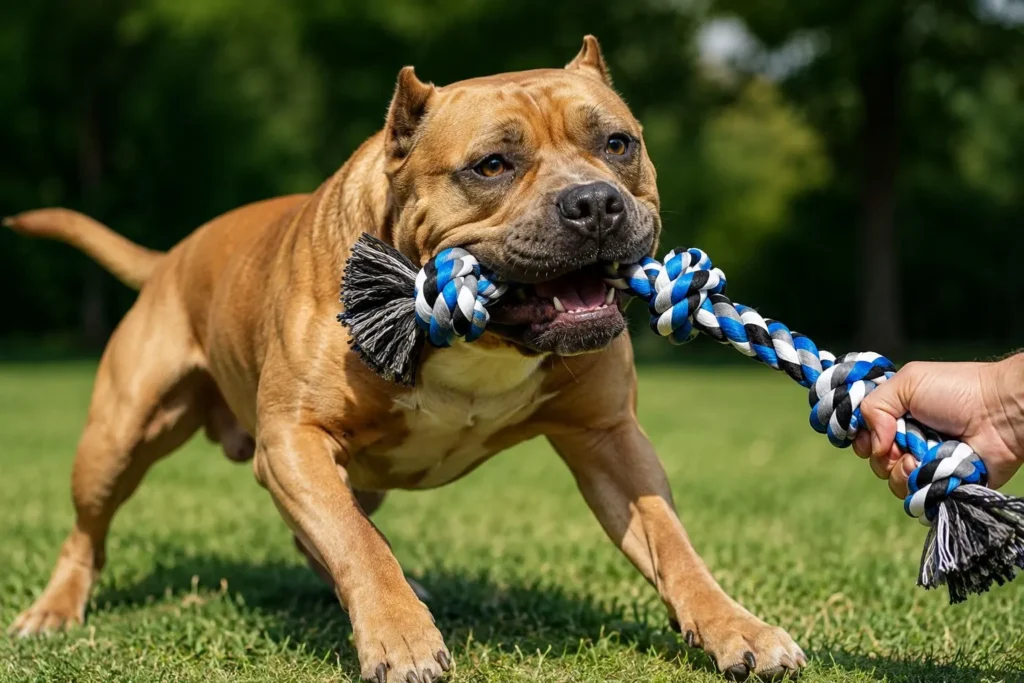
Tug-of-war with a small dog and tug-of-war with a large, strong dog are not the same game, even with the same rope. The force involved scales with the dog, and so does the risk to your hands if things get intense.
Rope length is your first line of defense here. The more distance between your grip and your dog’s mouth, the more room you have to react if your dog lunges forward or shakes the rope hard. A short rope puts your hand much closer to a fast-moving mouth than a longer one does, which is part of why length matters just as much for safety as it does for durability.
Grip matters too. Wrapping the rope tightly around your hand or knuckles isn’t a great habit with a strong puller — a sudden pull can jerk your hand along with it. A looser, adjustable grip you can let go of quickly gives you more control if the game gets more intense than planned. This is where a toy like our Double Ring Dog Rope Toy has an advantage — the ring handles give you a defined place to hold on, rather than gripping a bare length of rope.
It also helps to set a rhythm to the game instead of letting it run indefinitely. Starting the tug deliberately, taking short breaks to reposition your grip, and ending the session on your terms — rather than playing until your dog decides to stop — keeps things predictable, which is safer for both of you.
For dogs that pull with real force, our Heavy Duty Dog Rope Toy for Aggressive Chewers & Tug of War is built specifically for that kind of intensity, with extra length and reinforced knots to match. If your dog is more of a steady, moderate puller — especially in a multi-dog household where two dogs tug together — our Multi-Knot Dog Rope Toy spreads the grip across six knotted arms instead, though it’s not meant to stand up to the hardest power chewers the way the Heavy Duty option is.
Signs It’s Time to Replace Your Large Dog’s Rope Toy
A rope toy doesn’t fail all at once — it usually gives you warning signs first, if you know what to look for. Loose threads pulling away from the main braid, knots that have loosened or shifted from their original position, and spots where the rope looks thinner than the rest are all signals that it’s wearing down. On a large dog’s rope toy, these signs can show up faster than you’d expect, simply because of how much force goes into each chewing or tugging session.
It’s worth taking those signs seriously rather than waiting for the rope to fully come apart. Swallowed rope fibers are a real risk for dogs of any size — something we cover in more detail in the FAQ section below — but the short version is that a fraying toy is worth replacing before it becomes a problem, not after.
A simple habit helps here: check the rope over whenever you notice your dog has had an especially long or intense play session, rather than waiting for a scheduled check-in. Heavy use days are exactly when wear shows up fastest, and catching it early means one less thing to worry about. If you’re dealing with a dog that wears through toys unusually fast, our guide to rope toys for aggressive chewers goes deeper into picking a toy built for that specific chewing style.
Pingback: Are Rope Toys Safe for Dogs? The Honest Answer, Explained
Pingback: Best Animal Shaped Rope Toys for Dogs | Safe Pet Place
Pingback: Best Rope Ball Toy for Dogs: Sizing, Safety & Care Guide