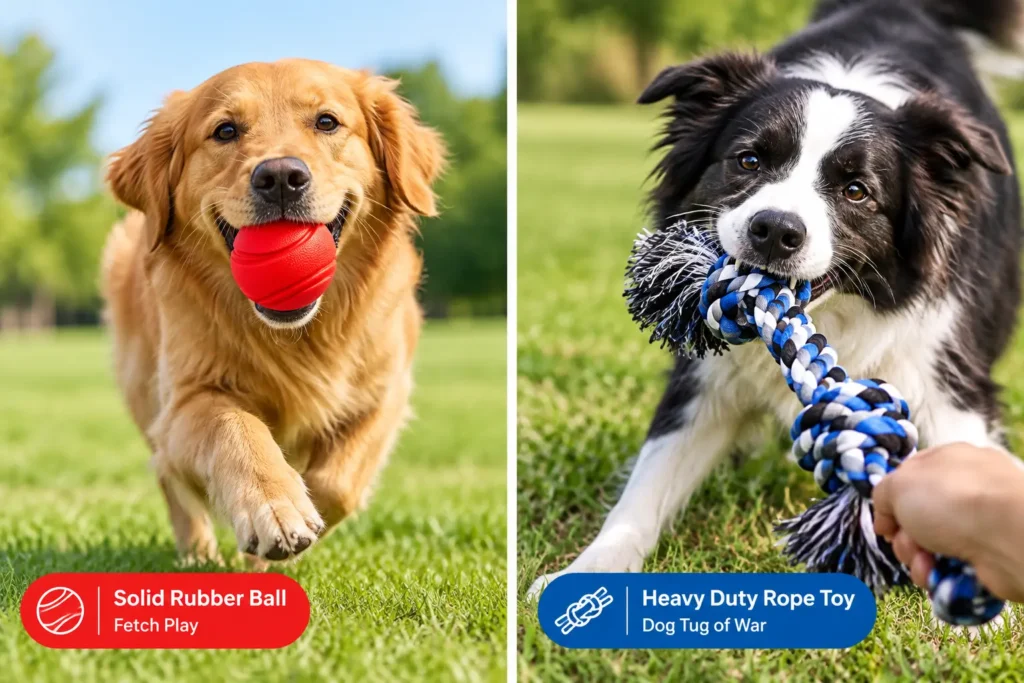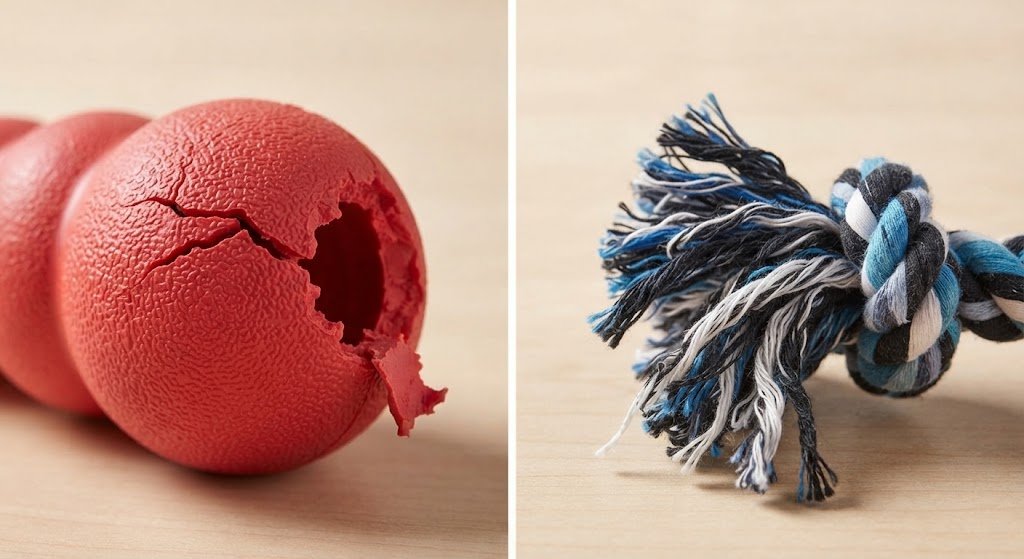
Your dog’s toy basket tells you more than you’d think. If the rope toys come out looking like a bad haircut within a week while the rubber ball barely has a scratch on it, that’s not bad luck — that’s your dog’s chewing style talking. Neither material wins the rubber dog toys vs rope dog toys debate outright, no matter what the packaging promises.
Which one holds up, cleans teeth better, and stays safer depends almost entirely on how your dog actually chews, not on which toy sounds tougher on the shelf. A gentle chewer and a dedicated power chewer need genuinely different answers here, and so does a dog who’d rather play tug than fetch.
This guide walks through the real differences — durability, dental benefit, swallowing risk, life stage, play style, and cleaning — using actual product data, so you can match the toy to your dog instead of hoping for the best.
Rubber Dog Toys vs Rope Dog Toys: At a Glance
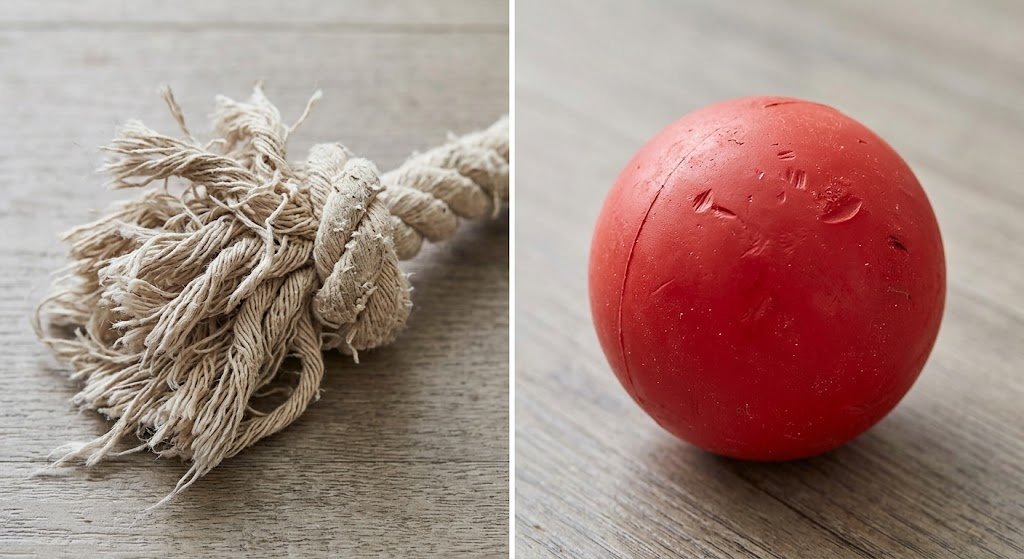
Here’s the short version before we get into the why behind each row below. Rubber and TPR toys generally win on raw durability and easy cleanup, since solid designs don’t have loose fibers to work apart.
Rope toys pull ahead on interactive play and a different kind of dental benefit — the flossing action from tugging fibers between teeth — but they need more supervision and a bit more laundry attention. Neither one is inherently the “safe” choice if a piece breaks off; the risks are just different in kind, which we cover in detail in the safety section below.
A table like this can only go so far, though. Within “rubber” alone, a soft latex ball and a dense solid-rubber ball behave nothing alike under a hard chewer, and the same is true of a loosely braided rope versus a tightly twisted one. The rest of this guide fills in those distinctions so you’re matching a specific toy to your specific dog, not just a material to a material.
| Factor | Rubber / TPR | Rope |
|---|---|---|
| Durability | Holds up well under repeated hard bites; solid designs resist tearing | Wears down faster under heavy chewing; strands fray with regular use |
| Dental benefit | Textured grooves scrub teeth through bite pressure | Fibers work like floss between teeth during tug and chew |
| Swallow risk | Comes from broken-off chunks | Comes from loose fibers, which the gut handles differently than a solid piece |
| Cleaning | Many rinse clean or are dishwasher-safe — check the specific product page | Hand wash and air dry only |
| Best for | Solo chewing, teething, fetch | Tug-of-war, interactive play |
You’ll find options for both in our rubber dog toys and dog rope toys collections. And if you can’t decide, a handful of toys blend both materials into one — we cover those near the end, along with who they genuinely suit and who they don’t.

Which One Fits Your Dog’s Chewing Habits
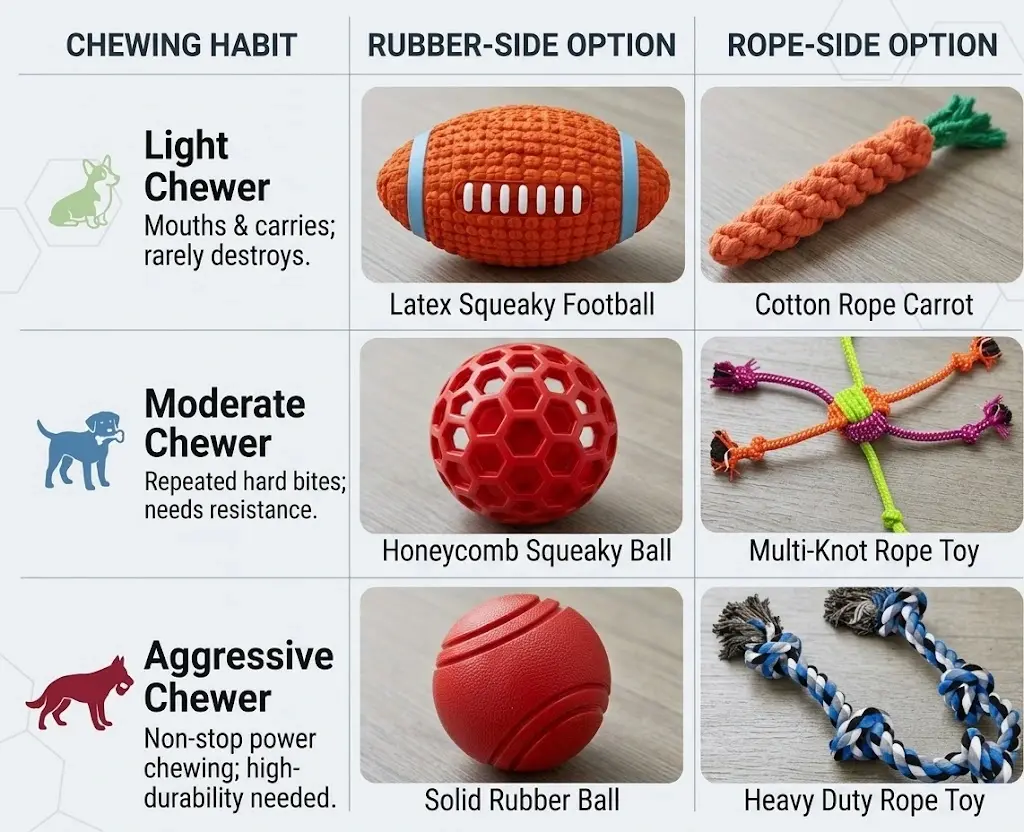
The honest answer to “rubber or rope” starts with a different question: how hard does your dog actually chew? Toy manufacturers often skip this step, but it matters more than material alone.
Light Chewers
If your dog mouths a toy more than it destroys one, almost anything in either category holds up fine. A soft rubber option gives some texture and squeak without much resistance — closer to the toothbrush-style toys and lighter latex balls covered in the puppy section below, since light chewers and puppies often have similar needs.
Standard rope toys don’t fray fast enough to be a real concern yet at this chewing level either. This category really comes down to what your dog enjoys more — the squeak and bounce of rubber, or the tug-and-carry feel of rope — and rotating between both keeps things interesting.
Moderate Chewers
Rotation matters more than picking a single winner here. On the rubber side, the Honeycomb Squeaky Ball is built from vulcanized natural rubber with deep hexagonal grooves specifically for moderate to determined chewers — its own product details are clear that it’s not meant for extreme power chewers, an honest distinction worth knowing before you buy.
On the rope side, a well-built multi-knot rope toy holds up similarly well under regular chewing and tugging, as long as you’re checking it for fraying. Neither is designed to survive nonstop, full-force chewing, so keep an eye on both and swap in a backup if one wears faster than expected.
Aggressive Chewers
Here’s where the two materials really split. The Solid Rubber Dog Ball is built specifically for this group — a dense, solid ball with no hollow core to cave in, available in three sizes depending on your dog’s weight. On the rope side, the Heavy Duty Dog Rope Toy is the sturdier option, using a tightly twisted, extra-long cotton construction instead of a looser braid.
It’s worth being upfront rather than overselling either toy: no rope is fully chew-proof against a determined power chewer, and the manufacturer’s own guidance is to swap it out once fraying starts. For this chewing style, rubber is the safer long-term bet, though a heavy-duty rope still works well for supervised tug sessions. For a deeper dive into keeping pace with a serious chewer, see our full guide to rope toys for aggressive chewers.
If you’ve got more than one dog and they chew differently, you don’t have to standardize on one material for the whole household. A light chewer and a power chewer under the same roof can each get the toy suited to them — just keep track of which toy belongs to which dog, since a toy built for gentle chewing won’t hold up if the wrong dog gets hold of it.

Durability: How Long Each Material Actually Lasts
There’s no honest single number for “how long will this toy last” — it depends on your dog, not the calendar. A determined chewer can wear through a rope toy in days; a gentle one might keep the same rubber ball intact for the better part of a year. Instead of a timeline, watch for the actual signs of wear.
On rubber and TPR toys, check for cracks, missing chunks, or spots that feel softer or gummier than the rest of the toy — several of our rubber toys’ own care instructions specifically recommend a weekly check for exactly these signs. On rope toys, watch for frayed ends, loosening knots, or strands starting to pull free; guidance across our rope toys consistently points to fraying as the signal to retire the toy, not a fixed number of weeks or months.

Construction quality within each material affects how fast you’ll see these signs — a denser rubber ball or a tighter rope twist simply gives a chewer less to work loose, which is why the specific picks in the chewing-habits section above are built the way they are.
It also pays to check right after an unusually intense session, not just on a routine schedule, since that’s often when a weak spot first shows up. Material subtype can affect wear too, though the exact difference varies by product, so it’s worth checking what a specific toy is made from rather than assuming all rubber or all rope behaves the same.
A toy that survives months of regular use is a better value over time than one you’re replacing every couple of weeks, even if it costs more upfront.
Dental Health: Grooves vs. Flossing — Which Cleans Better
Both materials can support dental health, but the mechanism is worth understanding rather than taking a “dental toy” label at face value.
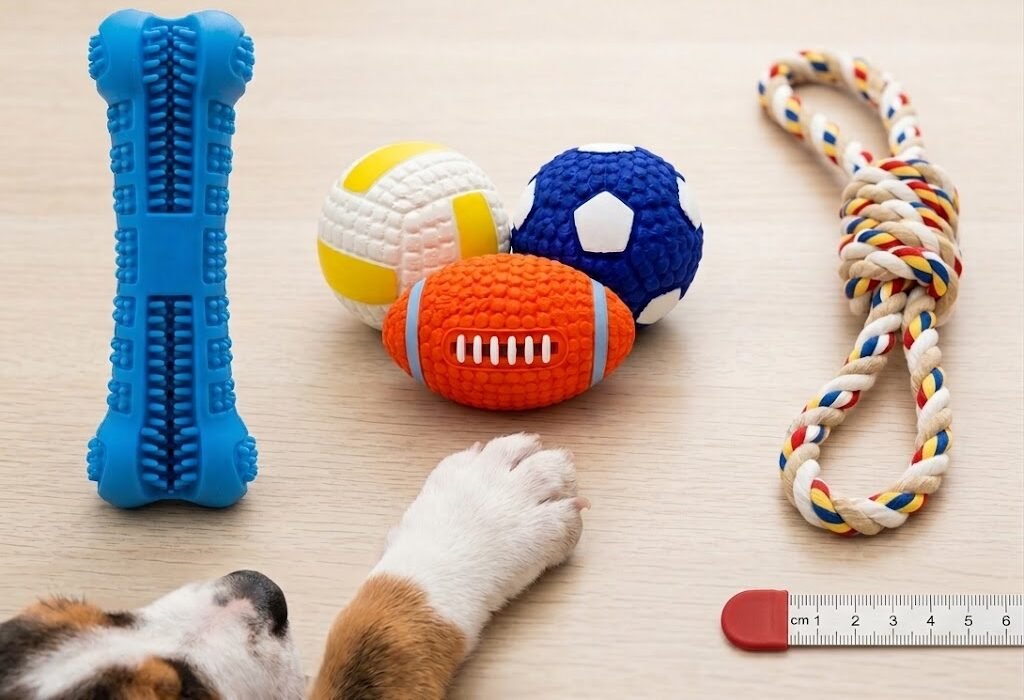
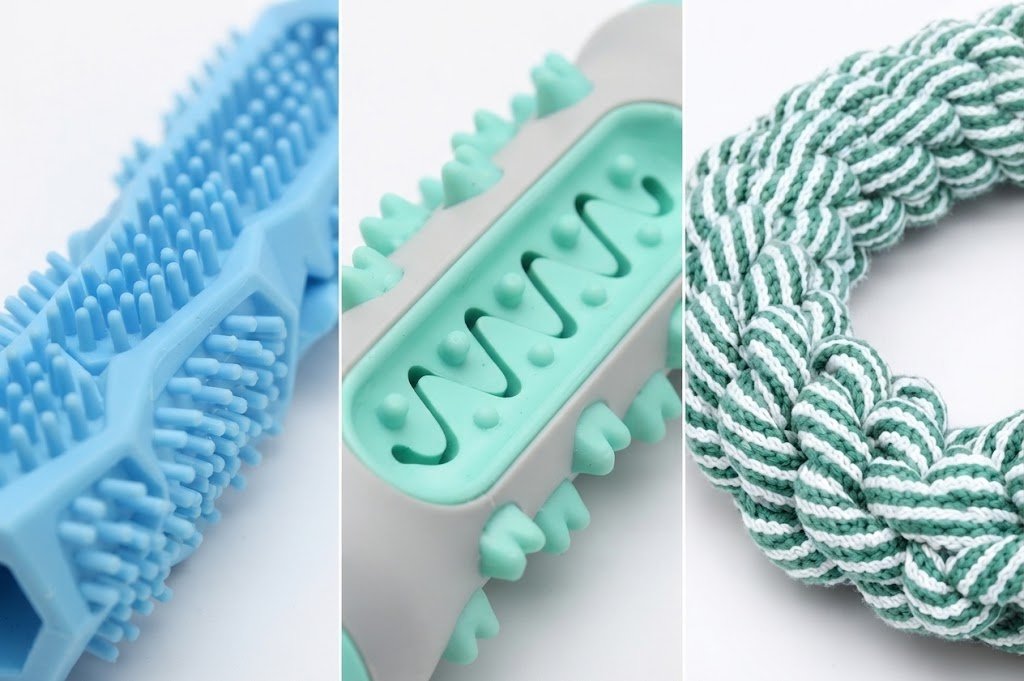
Textured rubber toys rely on raised ridges, nubs, or grooves that scrub against teeth and gums as your dog bites down. The Hexagonal Dog Toothbrush Stick and Dog Molar Toothbrush Chew Toy both use this approach, each with a hollow center for a bit of toothpaste or a treat, which extends chewing time and contact between the ridges and your dog’s teeth.
The hexagonal stick fits puppies and small-to-medium dogs; the molar toy is built for medium-to-large breeds. Sizing actually matters for the dental benefit itself, not just comfort — a toy that’s too big for your dog’s mouth won’t make full contact with the back teeth, and one that’s too small may not engage the molars at all.
Rope fibers work differently, sliding between teeth during chewing and tugging in a flossing-like motion along the gumline. The Cotton Rope Ring is often marketed around this exact benefit, since its braided design maximizes fiber-to-tooth contact during play.
The catch with rope is that the dental benefit only really happens during active chewing or tugging — a rope toy your dog carries around without gnawing on isn’t doing much for their teeth, the same way a rubber toy sitting untouched in the corner isn’t either.
Brushing and regular vet checkups still matter more than either toy — think of both as a helpful add-on, not a stand-in, and consistent use beats an occasional session either way.

Safety First: What Happens If Your Dog Swallows a Piece
If a piece breaks off, rope and rubber don’t behave the same way inside your dog’s body. That difference matters more than most toy descriptions let on.
Rope fibers can act as what veterinarians call a linear foreign body: a long, thread-like piece that anchors itself somewhere in the digestive tract while the rest of the intestine tries to move normally around it. This can cause the gut to bunch up along the strand, and in more severe cases, the strand can actually saw through the tissue as it moves.
A broken-off rubber chunk is typically a non-linear foreign body — it can still cause a dangerous blockage if too large to pass, but without that same anchoring, sawing effect. Cornell University’s College of Veterinary Medicine covers this distinction in detail, along with the warning signs: persistent vomiting, lethargy, loss of appetite, abdominal pain, and diarrhea.
Any of these after your dog has played with a damaged toy is worth an immediate call to your vet, even if your dog seems fine — obstructions can worsen quickly.
Material matters within each category too, not just between them. The Dog Rope Toy with Rubber Dental Ball’s own product details specifically address the risk of cotton rope fibers causing intestinal blockage if swallowed in quantity, while the Dog Ball on Rope’s details cover the same question for its nylon rope. Cotton and nylon don’t fray identically, which matters if your dog is a determined chewer rather than just a tugger.

If you’re ever unsure whether your dog actually swallowed something, a few details help a vet act faster: roughly how much material is missing from the toy, when you last saw your dog with it intact, and whether any of the warning signs above have started.
Having that on hand before you call can shave real time off getting the right care. Once a toy shows real damage — deep cracks, missing chunks, strands pulling loose — retiring it beats hoping it holds up one more session. For more on keeping rope play specifically safe, see our full guide to rope toy safety.
Puppies and Teething: Rope or Rubber First
Developing teeth and sore gums do better with softer materials than what you’d choose for an adult dog, and size matters just as much as material at this stage.
The Soft Rubber Dog Toothbrush Toy is made from food-grade TPR with a hollow chamber for toothpaste, in a smaller size built for dogs under 15 pounds — a good fit for most puppies. It’s explicitly not designed for aggressive chewing, which is actually a plus here, since gentle beats bite-force-resistant at this stage.
The Latex Squeaky Ball is another option, made from natural latex with a softer feel and sized small enough for a puppy’s mouth.
On the rope side, the Loop Handle Dog Rope Toy comes in a shorter length sized for puppies and smaller dogs, with two loop handles for early tug games alongside chewing. Its cotton construction is soft on developing gums while still giving a puppy something to work on during teething.
It’s worth introducing new toys one at a time rather than handing over several at once, especially early on — that way you can actually see how your puppy handles each material before deciding what to buy more of.
Puppies also grow into harder chewing fairly quickly, so a toy that’s soft enough now may need swapping out sooner than you’d expect once those adult teeth come in and the bite gets stronger.
Puppy play should stay supervised regardless of which material you pick — teething puppies chew harder and more persistently than their jaw strength suggests, which is exactly when small pieces are most likely to come loose. For more, see our full guide to rope toys for puppies.

Tug-of-War and Fetch: Matching the Toy to the Play Style
The right toy also depends on how you and your dog actually play together, since fetch and tug ask very different things from a toy.
Best for Fetch
Bounce-and-retrieve games favor rubber, mainly because of how the material handles impact and movement. The E-TPU Dog Ball uses a lightweight “popcorn” foam structure with a notably high bounce and lets it float, which makes it a solid pick if your fetch games sometimes head into a lake or pool — it’s sized in three options from small dog to large.
The Bite Resistant Dog Flying Disc suits a different kind of fetch: its flat, aerodynamic shape is built for longer throws across open space, and the flexible silicone-rubber blend bends instead of cracking on impact, which is gentler on your dog’s teeth during a hard catch than a rigid plastic disc would be. Both are built for retrieving, not sustained chewing, so neither is the toy to reach for if your dog wants to settle in and gnaw afterward.
Best for Tug-of-War
Sustained-grip play favors rope, since it gives both dog and owner (or two dogs) something substantial to hold onto through a real pulling match. The Multi-Knot Dog Rope Toy for Tug of War is built for exactly this, with a six-arm knotted design spreading grip points across multi-dog play or a dog-and-owner match; its cotton construction holds up well as long as you’re watching for fraying over time.
It doubles as a training reward toy too, since the knotted ends make it easy to toss and retrieve between sessions, which gives it a bit of fetch crossover if your dog enjoys both styles of play. A rubber ball can’t offer the same sustained grip, though — that’s really the deciding factor here, not safety or durability. For more, see our guide to rope-and-ball combination toys.

Cleaning and Care: Dishwasher-Safe vs. Hand-Wash Only
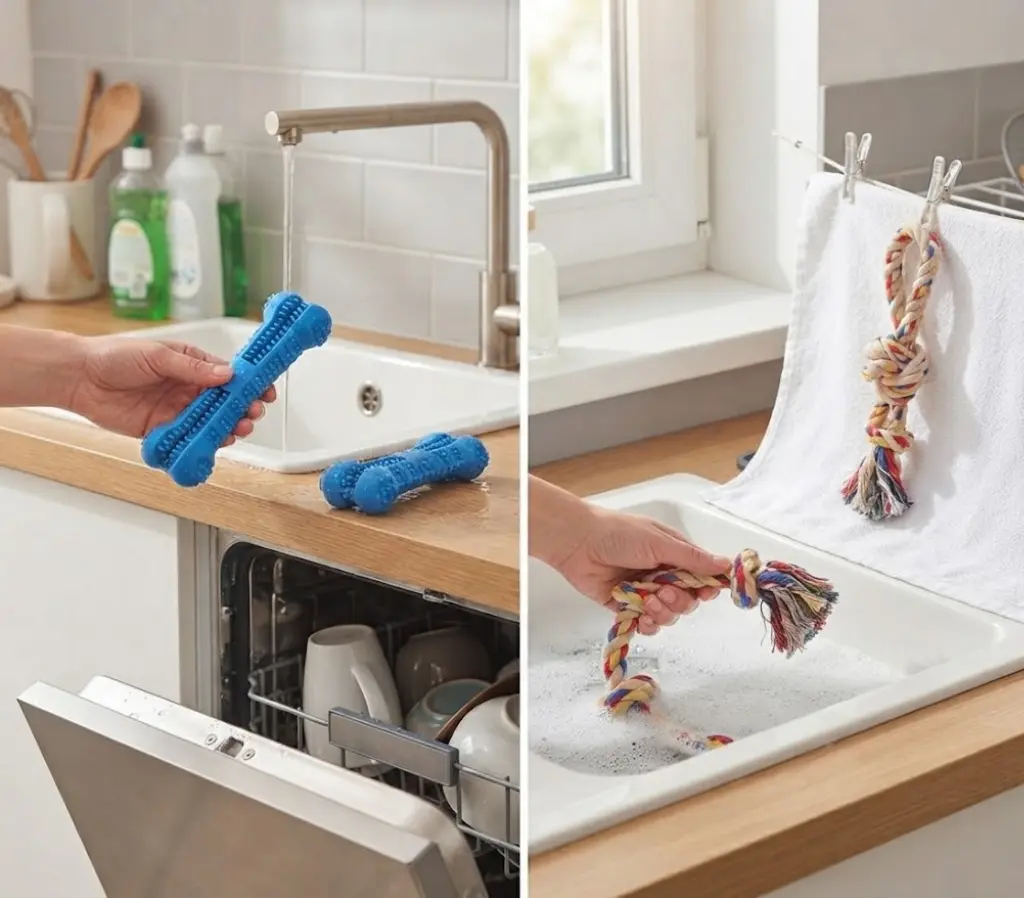
Many rubber and TPR toys rinse clean with warm water and mild soap, and some — like the Soft Rubber Dog Toothbrush Toy — are labeled safe for the top rack of a dishwasher. That’s not universal across every rubber toy, so check the specific product page. As a general rule, clean a toy whenever it looks visibly dirty or right after a muddy outdoor session, rather than waiting for a fixed schedule.

Rope toys need more attention: hand washing or a gentle cycle, followed by full air drying. Skip the dryer — its heat loosens fibers and speeds up fraying, working against the durability tips covered earlier. Make sure a rope toy is completely dry before it goes back into a toy bin or basket, too; packing away a damp rope with other toys is a good way to end up with a musty smell across the whole collection, not just the one toy.
If you live somewhere humid, rope also tends to hold onto moisture and odor more than rubber does, simply because cotton and similar fibers are more porous than a solid rubber surface. Rubber toys are the easier type to keep smelling fresh in that climate — a quick rinse usually does it.
Best of Both Worlds: When a Rope-Rubber Hybrid Makes Sense
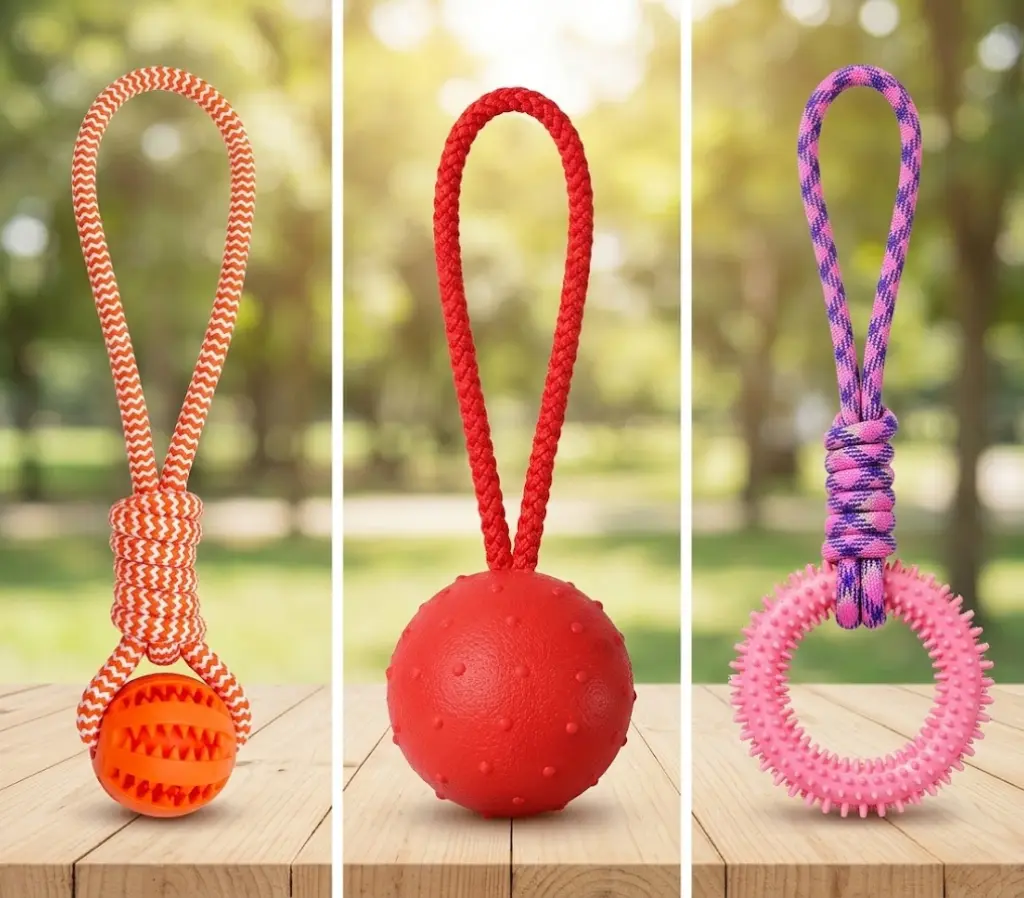
If you’ve read this far still torn between the two, a hybrid toy might solve the problem instead of forcing a choice. These combine a rope component with a rubber or TPR piece in a single toy, rather than asking you to buy and rotate two separate ones.
A hybrid genuinely suits moderate chewers who want the tug-and-floss feel of rope and the grooved dental texture of rubber together. It’s also a reasonable starting point if you don’t yet know your dog’s chewing category — a new puppy or a recently adopted dog, for instance — since watching how each half of the toy wears over the first few weeks tells you something useful.
If the rope section frays quickly while the rubber ball stays intact, that’s a sign your dog leans toward the harder-chewing end and might do better with a dedicated rubber toy going forward; if both hold up evenly, a hybrid or a rotation of separate toys works fine long-term.
The Dog Rope Toy with Rubber Dental Ball pairs a cotton rope with a textured rubber ball, and its own details specifically address aggressive-chewing safety and sizing for younger puppies — a reasonably well-documented option if you’re chewing-style-conscious.
The Spiked Dog Toy Ring with Rope takes a similar approach, pairing a spiked TPR ring with a rope section for a different texture and grip. For a rope component that holds up a bit longer than cotton, the Dog Ball on Rope uses nylon paired with a TPR ball, and its details also cover waterproofing — a reasonable pick for fetch-and-tug near water.
What a hybrid isn’t built for is a dedicated aggressive chewer who needs pure rubber density. The rope portion is still rope, and it’ll wear the way rope wears no matter what it’s attached to — a determined power chewer will likely work through it well before the rubber or TPR piece shows real damage.
For that chewing style, a solid rubber toy on its own remains the more durable choice, even if it means trading away some of the interactive tug appeal.
Whichever direction fits your dog best, you can browse the full range in our rubber dog toys and dog rope toys collections to find the right size and style.

Frequently Asked Questions
Which is safer if my dog swallows a piece — rope or rubber?
Neither is “safe” to swallow — the danger just looks different. Either way, call your vet right away rather than waiting to see what happens.
Can I leave a rope toy out unattended the same way I would a rubber toy?
Not quite — rope toys need more supervision, especially once fraying starts. Rubber holds up a bit better unattended, but retire either one once it’s damaged.
Do all dogs prefer the same toy type, or does it depend on the dog?
It depends on the dog. Steady gnawers often lean rubber; shake-and-pull dogs often lean rope.
My dog only tugs and never chews through the rope — is it still risky?
Lower risk, since no fibers are being broken down and swallowed. Still worth checking for loose threads before a hard tug session.
Is one material better overall, or does it really come down to my dog's chewing style?
Chewing style, more than anything. Light and moderate chewers do fine with either; aggressive chewers usually do better with rubber. Not sure which yours is? A hybrid or rotation is a safe starting point.


Pingback: Best Durable Rubber Dog Toys for Aggressive Chewers