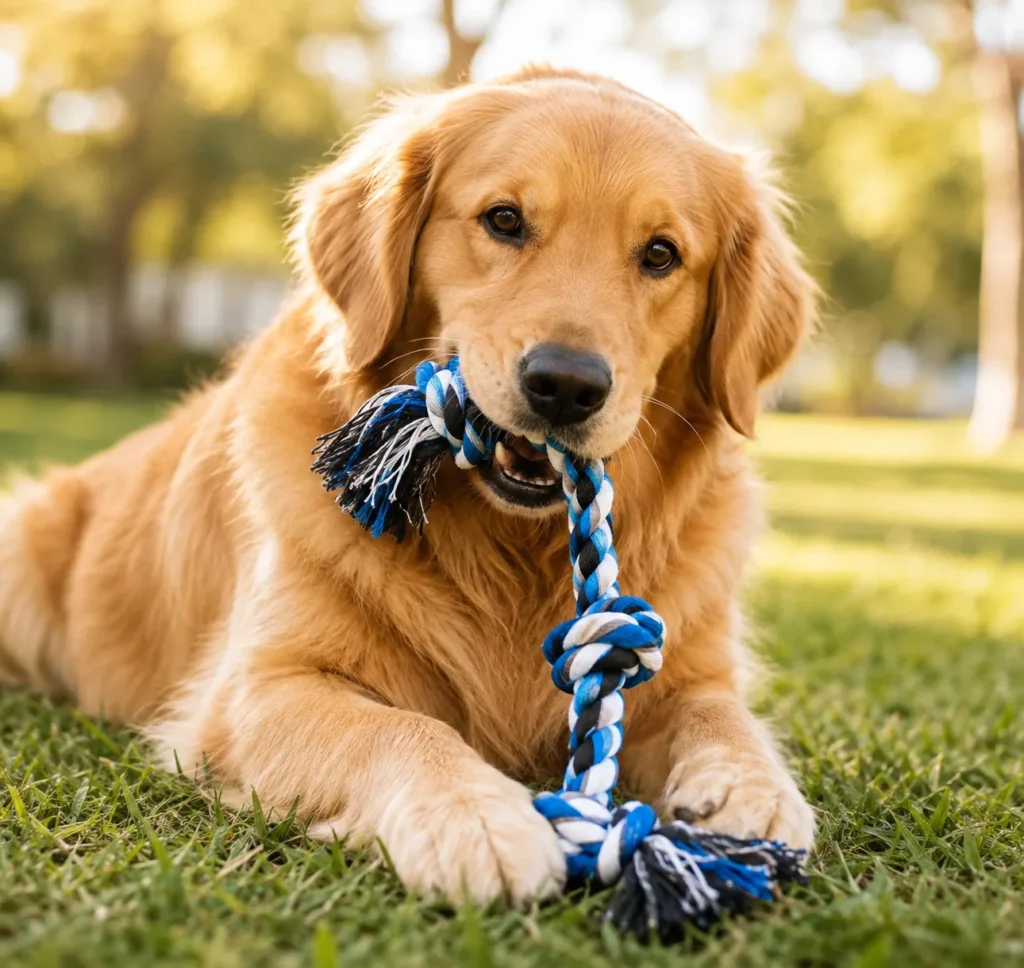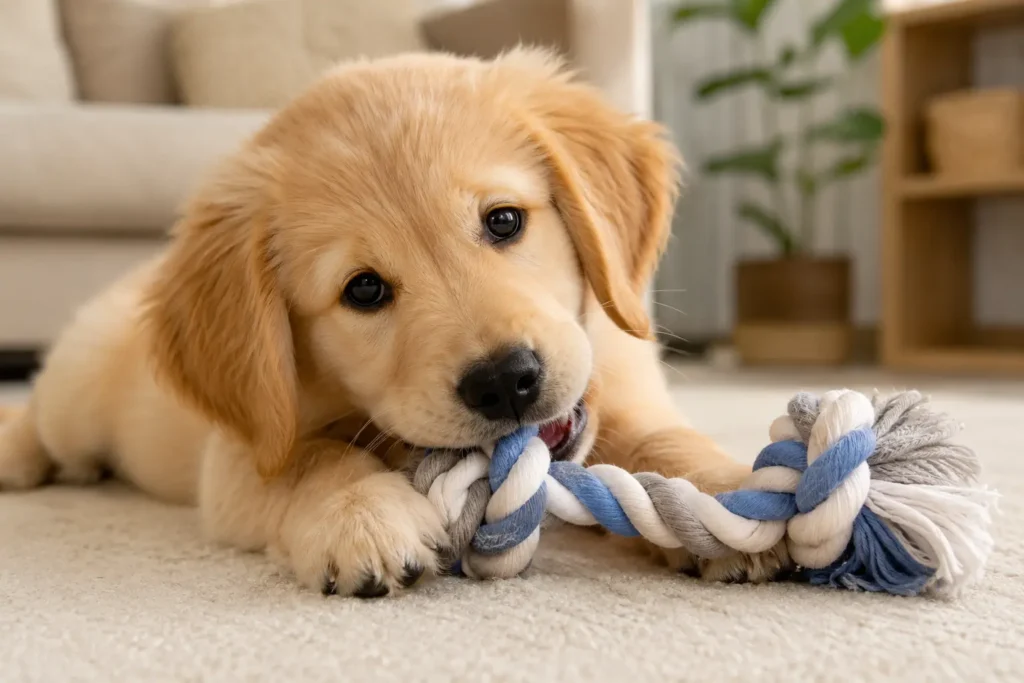
If you’ve bought a rubber toy labeled “built for aggressive chewers” and watched your dog destroy it by the weekend, the toy might not be the problem. The way you matched it to your dog’s bite strength probably is. Most buying advice tells you to pick a toy based on how hard your dog can bite. But bite force alone doesn’t predict how fast a toy gets torn apart. What matters more is how your dog chews: how persistent they are, and how they go after something. This guide explains the real difference, gives you a simple way to test where your dog falls, and helps you choose a rubber chew toy that actually holds up.

Jaw Strength vs. Bite Force vs. Chew Strength — What Actually Predicts Toy Destruction
Jaw strength is a physical trait: the size and structure of a dog’s skull and jaw muscles. It’s part of why certain breeds get described as “strong-jawed,” but on its own it’s a static feature, not a behavior, and it doesn’t tell you much about how a toy will hold up.
Bite force is the pressure a dog can generate in a single clamp-down. You’ve probably seen bite-force numbers in PSI floating around comparing breeds. The problem is that these figures get repeated from site to site, rarely trace back to a controlled study for that specific breed, and vary a lot depending on the source. Even where a number is roughly accurate for an average dog, individual bite force within a breed varies enormously. A single number doesn’t tell you how a toy in your own house is going to hold up.
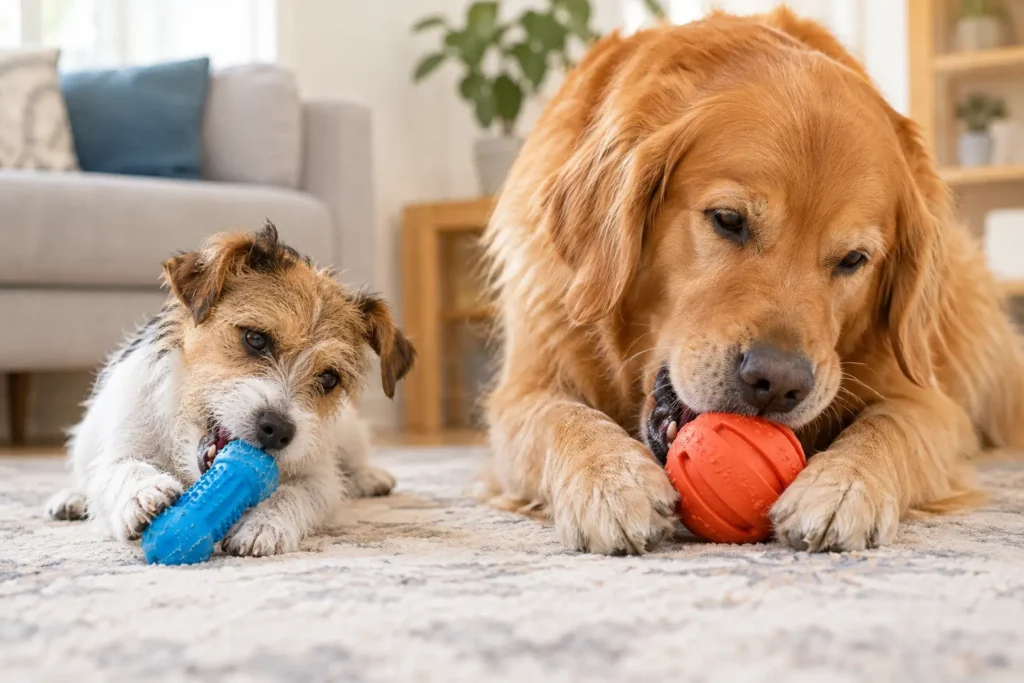
Chew strength, or chew persistence, is the variable that actually predicts toy failure. It’s not about how hard one bite is, but how long and how relentlessly your dog works on something.
A 25-pound terrier who won’t put a toy down for an hour can wear through rubber faster than an 80-pound dog who mouths a toy for five minutes and loses interest. That’s why a toy sized around bite-force charts can still fail with a smaller dog, and why a “moderate” toy can survive for years with a bigger, more laid-back one.
Since chew strength is behavioral rather than something you can look up by breed or size, the only reliable way to know where your dog falls is to watch how they actually chew.

A Simple At-Home Test to Find Your Dog’s Chew Tier
You don’t need any special equipment for this — just something to chew and a little attention. Give your dog a plain chew item they don’t already have strong feelings about, like a bully stick, a rawhide-free chew, or a spare rubber toy you don’t mind losing. Then watch how they treat it over one normal chewing session.
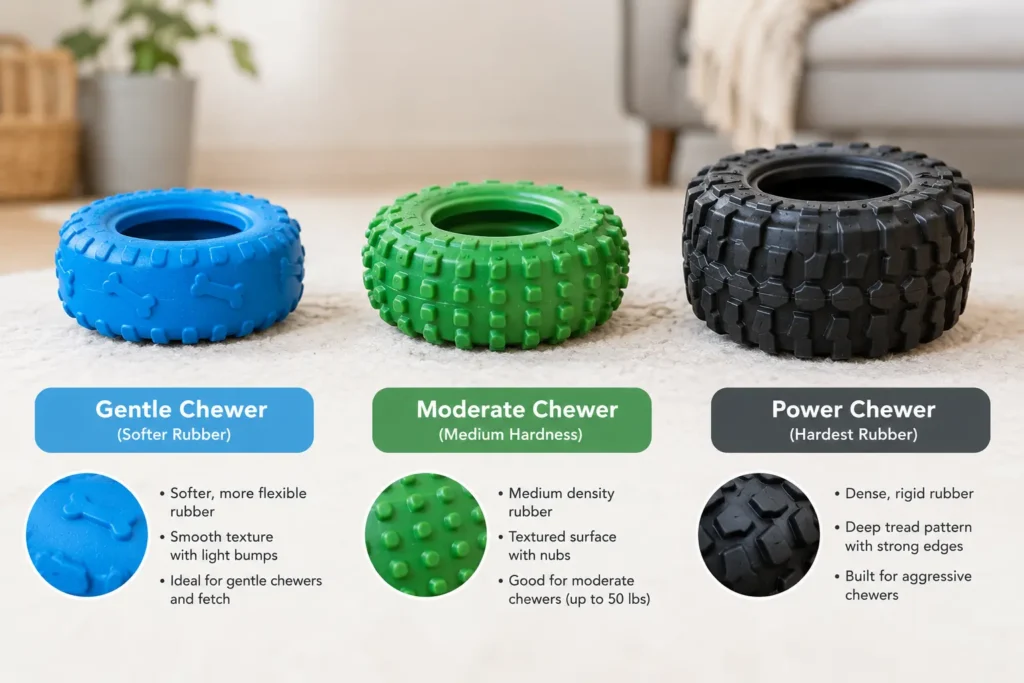
A dog that mouths it occasionally, sets it down, and comes back to it later, leaving it mostly intact after several sittings spread across a few days, is a gentle chewer. Toys don’t need much resistance here; the bigger risk is losing interest, not breaking through the material.
Most dogs fall into a middle group: steady work through most of one sitting, with real wear showing up (dents, tooth marks, small pieces coming loose) but the item still surviving. That’s a moderate chewer, and it’s often where “aggressive chewer” toys actually end up being used.
Finishing off or destroying the item within a single sitting, working at it nonstop, is the power-chewer pattern. This group needs solid, dense rubber with as few weak points as possible: textured edges, seams, or hollow spaces a dog can get a tooth into.
One test isn’t perfect. A dog that’s tired, distracted, or just not that interested in the specific item you picked might chew more gently than usual. If the result feels off, try again with a different item on a different day before you settle on a tier.
Matching Rubber Hardness to Your Dog’s Tier
Once you have a rough sense of where your dog falls, hardness (how dense and rigid the rubber actually is) should guide your pick more than the label on the packaging.
For a gentle chewer, a fetch-friendly rubber toy built for gentler chewers is a good fit, since it’s designed more for dogs who enjoy fetching and tossing than for ones who settle in and chew for long stretches. There’s no reason to pay for extra-dense rubber a gentle chewer will never actually put to the test.
For a moderate chewer, a textured rubber ball suited to moderate chewers (up to 50 lbs) works well — the honeycomb texture gives some grip that helps with gum and tooth health. It’s not built for dogs over 50 lbs or for the most determined power chewers, though; the textured edges are the first part to wear down under a very strong, sustained bite.

For a genuine power chewer, look for solid rubber with no hollow center and no textured edges to work loose. A solid rubber ball built for power chewers is sized from small dogs up through large breeds like Rottweilers, German Shepherds, and Pitbulls, with no weight-limit warning on its own product listing.
If your dog also likes fetch or water play, this chew-and-fetch elastic rubber ball is another solid-rubber option, built to float and bounce in a way the straight power-chew ball isn’t really designed for. If you’re not sure which of the two fits better, the solid rubber ball is the more direct match when chewing is the main activity, while the elastic ball makes more sense if fetch or water play is part of the routine too.
No rubber toy is meant to hold up forever against an unsupervised power chewer, no matter how dense it is. Hardness affects how long a toy lasts, not whether it can eventually be worn down.
Signs You’ve Got It Wrong — When to Size Up (or Down)
If a toy you picked based on the test above is getting torn into within days instead of holding up, or your dog seems more interested in destroying it than actually playing with it, that’s a sign to move up a tier rather than replacing it with something identical. On the other hand, if a toy is barely getting touched, that’s not always about hardness — check the shape and texture too, since some dogs respond more to something that squeaks or has an interesting shape than to a plain solid ball.
If you’re already using the power-chew tier, this no-compromise rubber ball is still the reasonable option to stick with — there isn’t really a “higher” category once you’re using solid, dense rubber with no weight limit. At that point, the more useful question becomes how closely the toy is being supervised, not which product to try next.
Multi-Dog Households: Buying for Different Chew Strengths at Once
If you have more than one dog and they don’t chew the same way, buying a single toy for the household usually backfires. The gentler chewer’s toy tends to get taken over by the more determined dog, or the power chewer’s toy sits ignored because it’s too tough to hold a gentler dog’s interest. It’s usually more practical to shop separately by chew tier for each dog, running the test above individually rather than assuming dogs in the same house share similar bite strength.
It’s also worth keeping toys separated during unsupervised time, since one dog can end up guarding or taking over a toy that was really picked for the other. You can browse our full lineup of rubber chew toys to compare options across all three tiers in one place.
When to Retire a Rubber Toy (Safety Signs)
Watch for cracks, missing chunks, or spots where the rubber starts to feel soft or gummy — VCA’s guide on choosing safe chew toys flags the same signs and recommends retiring anything showing this kind of damage before a piece can be swallowed. Even a toy that’s a good match for your dog’s tier is safer with occasional supervision, since this kind of wear can build up gradually between checks. If you want a closer look at wear signs and durability specifically for aggressive chewers, our deep-dive on durable picks for aggressive chewers covers this in more detail.
Frequently Asked Questions
Rubber vs. nylon — which is better for a power chewer?
Both hold up fine for a power chewer, just in different ways. Solid rubber gives a little under pressure, so it’s less likely to snap into sharp fragments. Nylon is harder and more rigid, which means it can crack or splinter instead of gradually wearing down. Neither one wins outright — go solid and non-hollow, then keep watching for the wear signs above no matter which material you
Can a small dog really be a power chewer?
Absolutely. Size and breed don’t decide chew strength — persistence does. A small dog who won’t quit can do just as much damage as a dog three times their size who loses interest in ten minutes. Skip the assumption that small means gentle, and just run the at-home test above.
Are rubber toys with squeakers safe for aggressive chewers?
Honestly, there’s no solid data on squeaker placement specifically, so treat it as a nice-to-have feature rather than a safety checkbox. What actually protects a power chewer is what we covered above: solid, non-hollow rubber that leaves less material to bite through in the first place, squeaker or no squeaker
Why does my dog chew so aggressively — is it normal?
Most of the time, that’s just who your dog is — a bigger, more determined chewer, not a red flag. If it’s always been this way, the right toy tier usually solves it. But if the chewing suddenly ramps up or shows up alongside other behavior changes, that’s a reason to call your vet, not just buy a tougher toy — sudden changes can point to something else going on.
Is there a real difference between "aggressive chewer," "power chew," and "strong chew" labels — or is it just marketing
Not really — these terms aren’t standardized across brands, so the same label can mean different things from one product to the next. One brand’s “power chew” toy might be built for genuinely heavy chewers, while another’s is closer to what we’d call moderate here. Skip the label and check what’s actually inside: solid or hollow, plus any real weight or chewer-type notes on the product’s own listing