The stuffing free vs stuffed dog toys question has a short answer. A stuffing-free toy takes away the loose filling a dog can pull out and swallow, but it doesn’t take away every risk. Squeakers, torn fabric, and a poor size match are a problem with either type, and plush of any kind isn’t the right pick for a hard chewer.
Below, we cover what actually changes when the stuffing is gone, which dogs suit each kind, and whether no stuffing really means a longer-lasting toy. We also look at what you give up in softness and play, then finish with habits that make either type safer.
What “Stuffing-Free” Actually Means on a Dog Toy
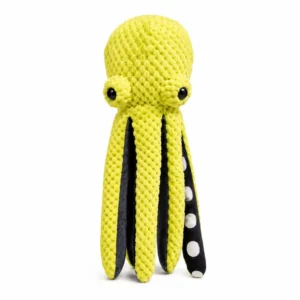
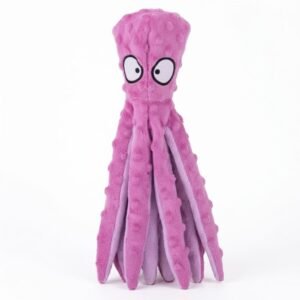
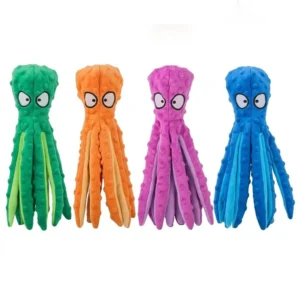
Shoppers see “stuffing-free” on a lot of listings, and the label doesn’t always mean the same thing. The simplest version is a flat plush toy, a fabric shell with nothing inside. Our flat stuffing-free duck is this style, a flat crinkle duck about 15 inches long. Our squeaky plush octopus is also stuffing-free.
Other designs fill the space with something else. Some lean on sound, with a large squeaker or crinkle material in the limbs. Others use knotted rope inside, or a pocket that holds an empty plastic bottle for extra crunch. Some toys sold as stuffing-free still keep a little fill, such as in the head only, so the label alone doesn’t settle it. Read the toy’s description to see what’s actually inside.
“Stuffing-free” also describes the fill, not how the toy should be used. The page for our flat duck says it isn’t meant for unattended or crate use, a reminder that a toy with no filling still needs a watchful owner.
Stuffing Free vs Stuffed Dog Toys: What Changes and What Doesn’t
A stuffing-free toy removes one specific hazard: loose filling that a dog can pull out and swallow. It doesn’t remove the rest of the list, and that’s the honest answer to “which is safer.” A dog that likes to tear plush open is better matched to stuffing-free on that one point, but overall safety still depends on the dog and the toy.
Humane World for Animals’ dog toy safety tips explain why filling matters. Even stuffing sold as safe isn’t truly digestible, so anything that spills from a seam is something you don’t want a dog eating.
| What to compare | Stuffed plush | Stuffing-free plush |
|---|---|---|
| Loose filling to swallow | Can spill out once a seam opens | Little or none to pull out |
| Mess | Fluff can scatter across the room | Much less to clean up |
| Squeaker or crinkle parts | A dog can still go after them | Same |
| Torn fabric and seams | Can still tear into pieces | Same |
| Toy size | Too small can be swallowed or lodged in the throat | Same |
The shared rows are where most of the remaining risk sits. A squeaker is usually a small plastic part, and plenty of dogs go hunting for the source of the noise. That’s the reason Humane World recommends supervising play with squeaky toys, since a dog that finds the squeaker may swallow it.
Fabric works the same way. Once a seam opens on a stuffed toy, you get fluff and cloth. On a flat toy, the cloth and the squeaker are what’s left to get at. AKC’s Retrievist also notes that stuffing-free toys aren’t meant to be swallowed, and that no toy comes with guarantees.
Which Dogs Suit Stuffed Toys and Which Suit Stuffing-Free
Chewing intensity is the first thing to look at.
Light to moderate chewers can do fine with either type when someone’s watching. Humane World points out that soft stuffed toys serve several purposes but aren’t appropriate for every dog. A dog that rips plush open within minutes is a better match for a stuffing-free design, because there’s no filling to pull out. The fabric and squeaker are still there, so that dog still needs close supervision.
Heavy chewers are where plush of either type is the wrong tool. Soft toys aren’t indestructible, and a hard chewer tests that fast. For these dogs, look at durable rubber toys for aggressive chewers instead.
Size comes next. Humane World says a toy that’s too small can be swallowed or lodged in a dog’s throat, so size by the dog, not the style. A small flat toy can be a poor fit for a large dog, and a very long one can be awkward for a small dog.
Supervision level counts too. Handing over a toy while you’re in the room is a different decision from leaving one in a crate or yard.
On our own plush range, the honest picture is simple: none of our plush toys is positioned for aggressive chewers, and nearly every product page asks for light to moderate chewing with supervision. A stuffing-free label doesn’t change that.
What You Give Up Without the Stuffing
Dogs want different things from a soft toy. Humane World points out that some dogs treat a plush toy like a companion and carry it around, while others want to shake it hard. Stuffing changes how each of those feels.
A dog that carries or sleeps with a toy may like a soft, rounded body to rest against. A stuffed toy supplies that, like our calming duck toy, a soft stuffed duck that comes in three sizes with PP cotton filling and an embroidered face. Like any plush toy, it’s best for supervised play. A flat toy gives you a lighter, thinner shape instead. It’s easy to carry and toss, but there’s less to lean on.
For dogs that shake and shred, owners describe both outcomes. One owner posted that their dog works a flat toy to one end and whips it side to side, squeaking with every swing. A dog that loves pulling filling out may find a flat toy less satisfying, since that part of the game is gone. It’s hard to predict which kind your dog is until you try.
None of this is a safety point. It’s about whether the toy gets played with at all.
Safe-Use Habits That Apply to Both Types
Whichever type you pick, a few habits do most of the work.
- Save squeaky toys for times you can watch. Stuffing-free or not, the squeaker is the part a dog may go after.
- Check the size. A toy should be too big to swallow or get lodged in the throat.
- Look it over after play. Run your fingers along the seams and check for loose threads or parts a dog could chew off, like ribbons or eyes. Humane World recommends discarding toys that are torn or breaking into pieces, and that applies to stuffing-free toys too.
- Read the label on stuffed toys. Humane World suggests choosing stuffed toys labeled safe for children under 3 and free of problem fillings such as nutshells or polystyrene beads.
- Follow the care instructions. Our stuffing-free squeaky plush octopus can be machine washed in a mesh bag, according to its product page. Other toys vary, so check each toy’s own care details first. For more on fillings and washing, see our plush dog toy safety guide.
- Call your vet when needed. Contact your veterinarian when a dog swallows part of a toy or seems unwell afterward, rather than waiting to see what happens.
Choosing between stuffing free vs stuffed dog toys comes down to matching the toy to the dog. Stuffing-free removes loose filling and keeps the room cleaner, while a stuffed toy gives some dogs a soft body to carry. Neither replaces the right size, a close eye on squeakers and seams, or a tougher kind of toy for hard chewers. Pick based on how your dog plays, then check the toy often.