
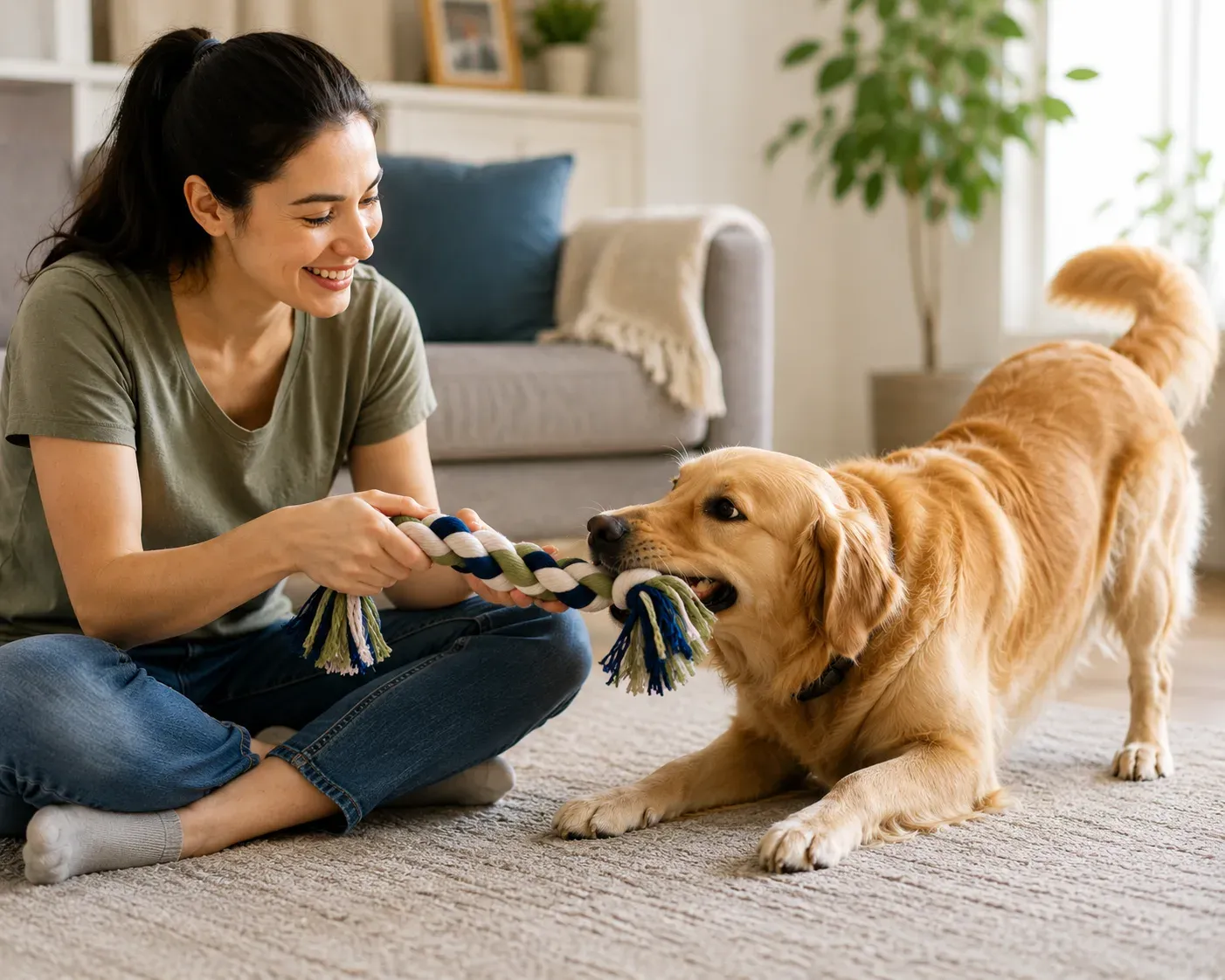
If you’re wondering whether rope toys are safe for dogs, here’s the short answer: generally yes, as long as you’re actually there to watch them play. The rope itself isn’t the real problem — it’s what can happen if a dog pulls a piece loose and swallows it while nobody’s paying attention.
This guide walks through what actually makes rope toys risky, which dogs need extra caution — aggressive chewers, puppies, and dogs prone to swallowing things they shouldn’t — how cotton and synthetic materials compare, what to reach for instead if rope isn’t the right fit, and what to do if your dog does swallow part of one. If you’d rather jump straight to browsing, our rope toy lineup is worth a look too. None of this is meant to scare you away from rope toys, just to help you use them the way they’re actually meant to be used.
What Actually Makes Rope Toys Risky
Rope toys get a bad reputation for one specific reason: what can happen if a dog swallows a piece of one. Vets call it a linear foreign body — a long, string-like object that gets stuck partway through a dog’s digestive tract instead of passing through cleanly.
Here’s the mechanism in plain terms. If one end of a swallowed rope fiber snags somewhere in the stomach or intestines while the rest of the digestive tract keeps trying to push it along, the intestine can’t move normally around it.
The gut bunches up along the length of the string, sometimes cinching down hard enough to cut off blood flow or tear through the intestinal wall. It’s a genuine medical emergency, and it’s why “wait and see” isn’t good advice if you suspect it’s happened. VCA Animal Hospitals has a good overview of how this kind of foreign body ingestion works if you want more detail.
One detail that catches a lot of owners off guard: rope fibers don’t reliably show up on an X-ray the way a bone or a coin would. A vet can’t always confirm a swallowed rope fiber with a quick scan — sometimes it takes exploratory surgery or other imaging to find it, which is part of why acting fast on symptoms matters more than waiting for a clear diagnostic picture.
There’s a second, much lower-stakes risk worth knowing about too: rope toys that don’t get washed can pick up bacteria from drool, dirt, and whatever surface they’ve been dragged across. It’s not usually dangerous, but it’s a good reason to clean a rope toy every so often rather than letting it sit in a damp pile in the yard.
None of this means rope toys are inherently dangerous. It means the risk is almost entirely tied to what happens when nobody’s watching — a dog working a loose thread apart, chewing through a whole section, and swallowing it before anyone notices. Supervision doesn’t eliminate the risk, but it’s the single biggest factor in whether a rope toy stays a fun way to play tug or turns into an emergency vet visit.
Can Dogs Choke on Rope Toys?
That intestinal-blockage risk above is a slow-building one. Choking is the fast version — a different danger that’s worth understanding on its own.
Choking happens in seconds, not hours. A piece breaks off, gets lodged in the throat, and blocks the airway right away — you’d notice immediately, not gradually the way a swallowed-fiber blockage can develop.
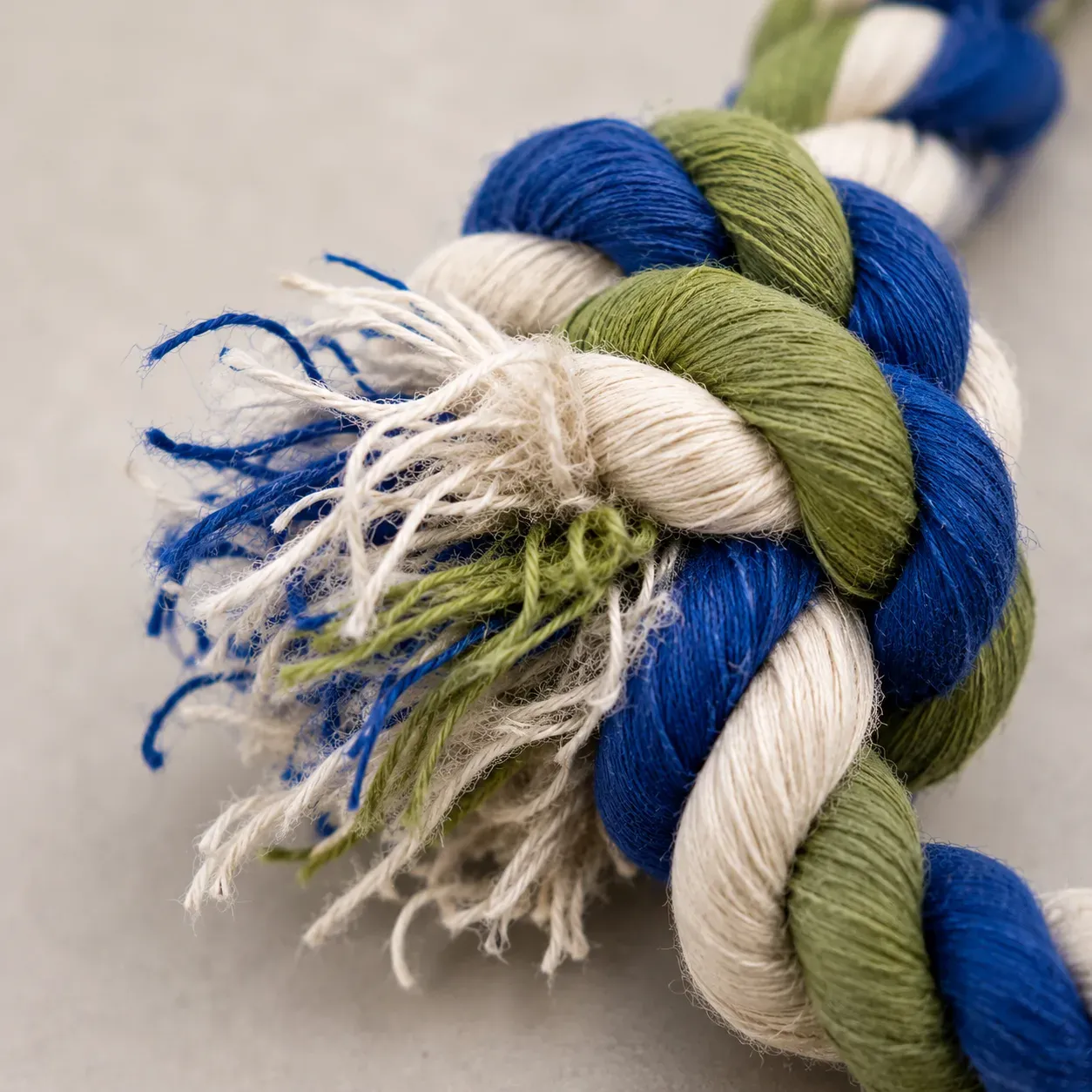
Loosely woven rope is more likely to shed a chunk large enough to choke on, especially around knots that have started to fray and pull apart. A tightly twisted or braided rope tends to hold together as one continuous piece rather than breaking into chokeable fragments, which is part of why weave quality matters as much as the material itself.
Size matching plays a role too. A rope toy sized for a much smaller dog gives a bigger dog less rope to work with relative to their mouth and throat, which can raise the odds of a piece getting swallowed whole rather than worked down gradually. Picking a toy sized to your dog, not just whatever’s cheapest or on the shelf, is a simple way to cut down on this specific risk.
Are Rope Toys Safe for Dogs With Aggressive Chewing Habits?
Choking and blockage risk both get worse with one specific kind of dog: the hard, fast chewer. So it’s worth asking directly — are rope toys even the right toy for that dog in the first place?
The honest answer is: it depends more on your specific dog than on rope toys as a category. “Aggressive chewer” covers a wide range — some dogs chew hard but still take their time working through a toy, while others can shred one in minutes. The harder and faster a dog chews, the more fiber they can work loose in a short window, which is exactly the scenario that raises real risk.
Here’s something worth knowing: several of our own rope toys are upfront about not being built for the hardest chewers, and that’s worth listening to rather than working around. Our double-ring tug rope is designed for regular tug-of-war with medium to large dogs, but its own product details are clear that it isn’t meant for dogs that aggressively shred toys or swallow rope fibers.
The six-knot version built for tug-of-war tells a similar story — solid for steady, moderate chewing and multi-dog households, but not the best match for the most extreme power chewers. Go a size down and the picture shifts again: our braided cotton rope ring is built with light-to-moderate chewers in mind and specifically isn’t recommended for aggressive ones, and the carrot-shaped rope set we carry goes a step further — its own listing says plainly that a large or aggressive chewer will wear through it quickly, rather than overselling what it can hold up to.
None of that means your dog can’t have a rope toy at all. It means matching the toy to how your dog actually plays, not how you wish they played. If your dog is a confirmed hard, fast chewer who’s already gone through other toys quickly, a rope toy probably isn’t the best fit for unsupervised time — even a well-built one.
If that sounds like your dog, we’ve got a full breakdown of what to look for in a tougher rope toy. And if your dog is also large or heavy-bodied, our guide to picking the right size for big dogs covers length and tug-of-war safety in more depth. Later in this guide, we’ll also cover a few non-rope alternatives that tend to hold up better for hard chewers.”
Are Rope Toys Safe for Puppies?
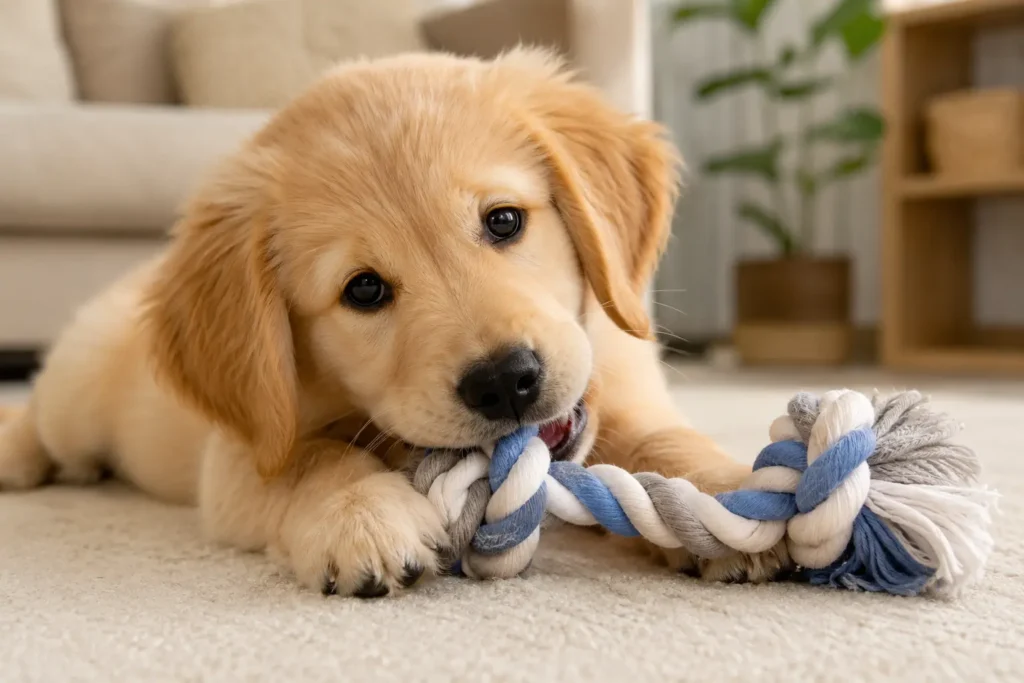
Puppies sit at the other end of the spectrum from power chewers, but they come with a risk of their own: less judgment about what’s actually safe to swallow. A teething puppy working on a rope toy isn’t necessarily being careful about biting off more than they should, especially once the texture starts to feel good against sore gums.
That said, rope can genuinely help during teething. The give in a soft, twisted cotton rope is gentler on inflamed gums than hard plastic or rubber, and the texture gives a puppy something satisfying to work their new teeth against.
Our smaller loop-handle rope comes in a size built with teething puppies in mind, and our elephant, giraffe, and duck-shaped chew ropes along with the rope-and-ball combo toy are both sized for small mouths as well. The carrot-shaped rope set is built specifically with gentle chewers like puppies in mind, and our compact double-knot rope comes in a size meant for puppies and small breeds too.
The tradeoff is that puppies usually need closer supervision than an adult dog would with the same toy, not less. If you’re working through the teething stage, we’ve put together a sizing and material guide just for puppies that goes deeper into that specific age and stage.
 Cotton vs. Synthetic — Which Rope Material Is Safer?
 Cotton vs. Synthetic — Which Rope Material Is Safer?
Chewing style and dog size aren’t the only variables — the rope material itself changes how a toy fails when it eventually does. Neither material is risk-free, but they fail differently, and that difference matters if you’re trying to pick the safer option for your dog.
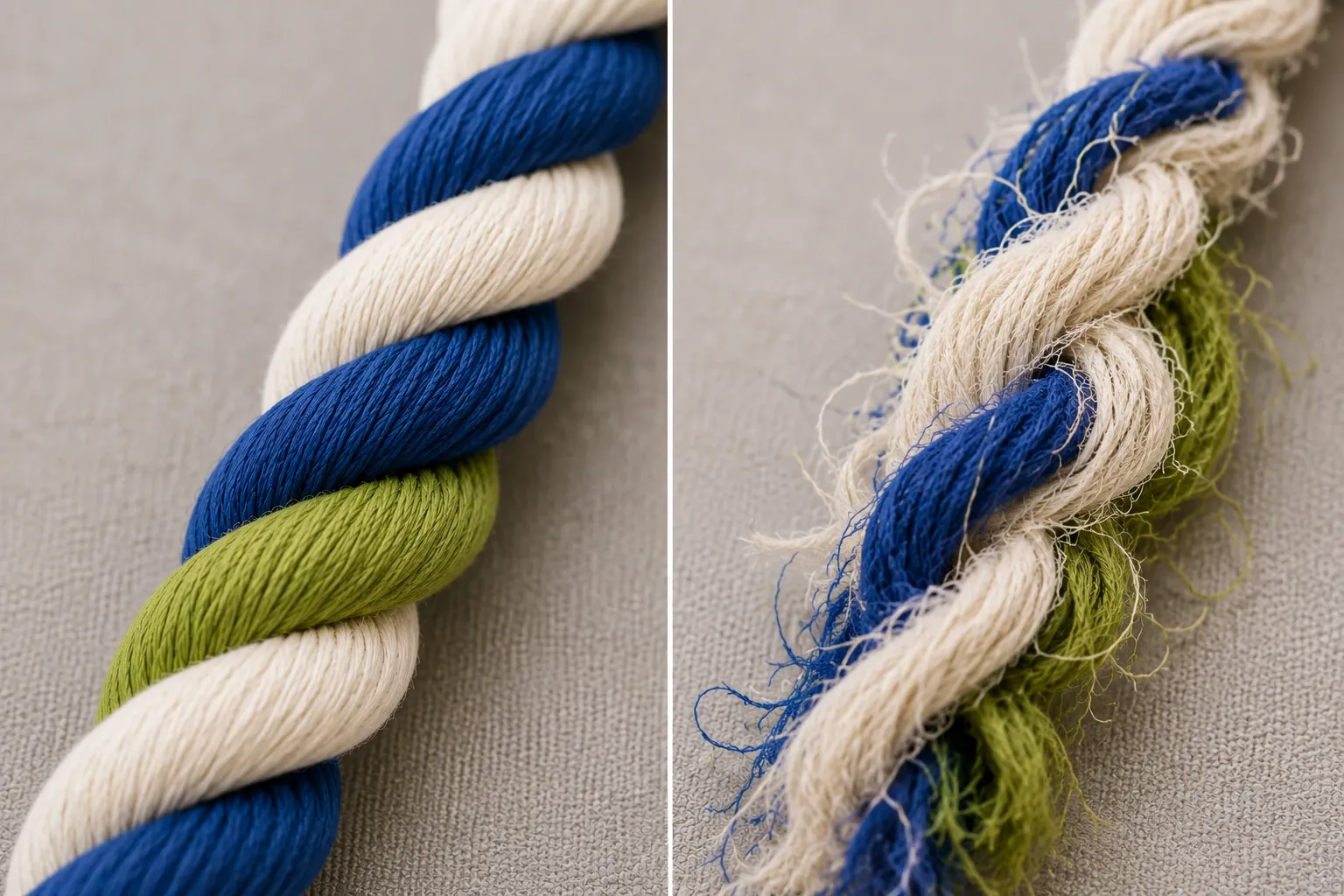
Cotton tends to fray into visible, individual strands before it fully comes apart. That’s actually a small safety advantage — you get a warning sign, like loose threads or a knot starting to loosen, before the toy is in real danger of shredding into swallowable pieces. Synthetic rope is often more durable against wear, but when it does fail, it can shred into smaller, less visible pieces that are easier to miss during a quick glance-over.
Our cotton rope ring is made from 100% cotton, which fits that same fray-as-a-warning-sign pattern. Our thick, tightly twisted rope built for determined chewers and rope-and-ball chew combo are also cotton-built, tightly twisted or braided rather than loosely wound, which holds up longer before it starts to visibly fray.
The practical takeaway either way: a tightly constructed rope, with knots that hold their shape and don’t loosen quickly, is safer than a loosely woven one regardless of exact material. Check any rope toy the same way no matter what it’s made from — regularly, and especially right after a hard chewing session.
 Safer Rope Toy Alternatives
 Safer Rope Toy Alternatives
If your dog is a confirmed hard chewer, or you’d rather not risk unsupervised rope play at all, one of our other toys is built from a different material that fails in a different way.
Our bungee-handled tug toy made for aggressive chewers swaps rope for a soft microfiber mop-style head paired with a shock-absorbing handle. It’s built to handle harder pulling and chewing, and it’s made without high-concern chemicals — but it’s still not meant for unsupervised play. Like any tug or chew toy, it needs regular inspection, and any loose or frayed section should mean retiring it, the same rule that applies to rope.
Beyond that, solid rubber and nylon chew toys are generally a safer bet for dogs who chew unsupervised for long stretches, since they don’t break down into long, swallowable strands the way rope does. If you’re shopping specifically for a dog that goes through toys fast, it’s worth prioritizing that kind of construction over anything rope-based, even a heavy-duty one, for the times you can’t watch them closely.
What to Do If Your Dog Swallows Rope Fibers
Watch for these signs if you think your dog swallowed part of a rope toy:
- Vomiting, especially if it happens more than once
- Lethargy or seeming unusually quiet
- Loss of appetite
- A tender or painful-looking belly
- A noticeable change in their stool
None of these symptoms are exclusive to a swallowed rope fiber, which is part of what makes this risk tricky — they can look like a routine upset stomach at first and get worse from there.
If you see any of these signs, or you know or strongly suspect your dog ate part of a rope toy, call your vet right away. Don’t wait to see if it passes on its own.
One specific warning worth remembering: if you can see part of a string caught on a tooth or wrapped around your dog’s tongue but you can’t see the other end, don’t pull on it. Pulling can drag the string further into the digestive tract or make existing damage worse. Get your dog to a vet instead and let them handle it safely.
Acting quickly matters more here than almost anywhere else in dog toy safety. The sooner a swallowed rope fiber gets found and dealt with, the better the odds of a straightforward recovery instead of emergency surgery.
Quick answer, if you’re short on time: Supervised rope play is generally safe. The real risk is unsupervised chewing — a dog left alone to work a toy apart and swallow the pieces. Watch for fraying, replace worn toys early, and call your vet immediately if you suspect your dog swallowed any rope fibers.
Pingback: Best Animal Shaped Rope Toys for Dogs | Safe Pet Place
Pingback: Best Rope Ball Toy for Dogs: Sizing, Safety & Care Guide
Pingback: Rubber Dog Toys vs Rope Dog Toys