
A seam on your dog’s favorite plush toy has started to open, and you’re not sure whether to keep it or toss it. These are the signs your dog’s plush toy needs replacing, what each one means, and a one-minute check you can repeat any time. No calendar date settles the question, because the veterinary and safety guidance behind this article sets no replacement date for plush toys. The toy’s condition does, and it’s easy to read once you know where to look.
Signs Your Dog’s Plush Toy Needs Replacing, Part by Part
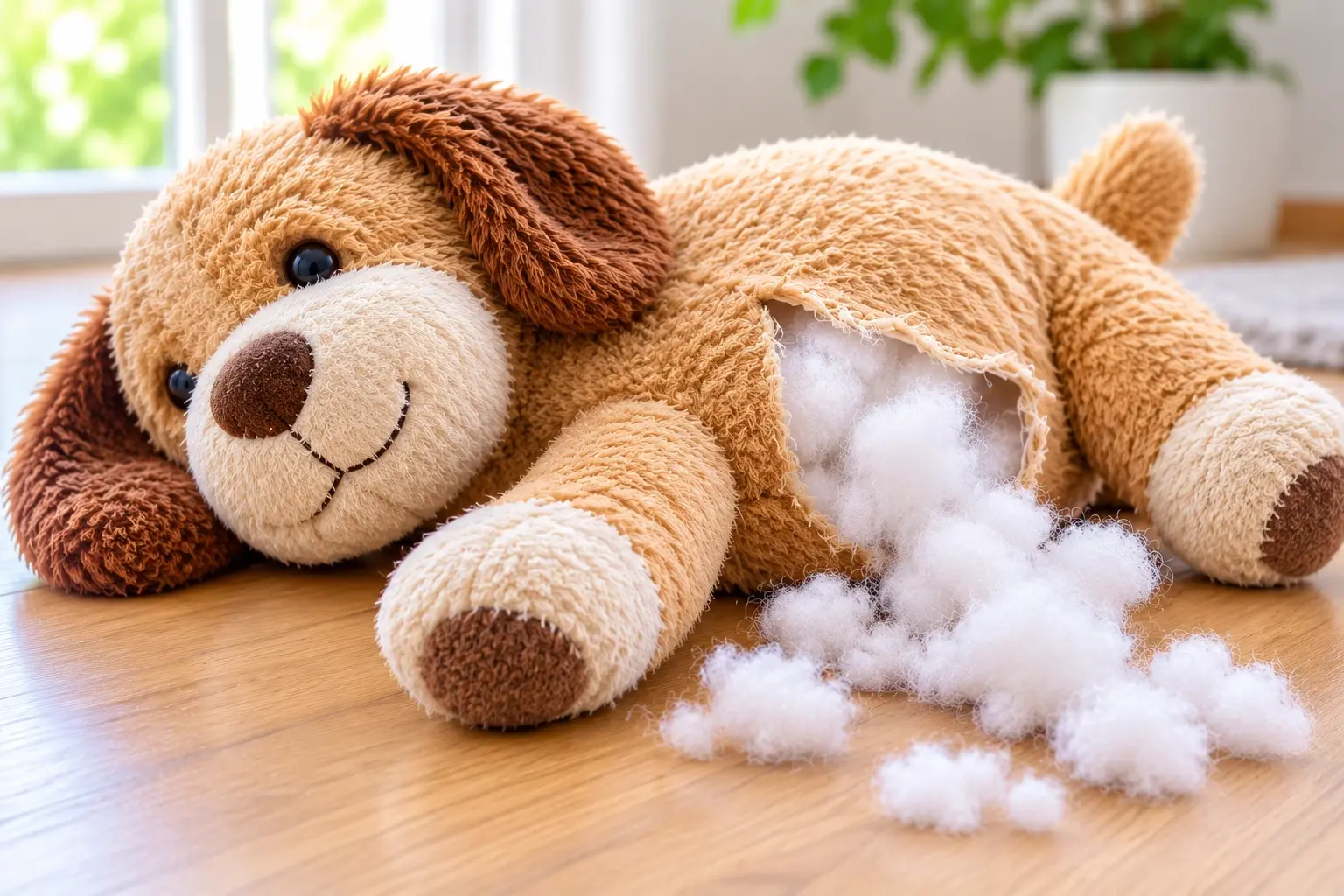
When should you throw away a plush dog toy? Retire it once it is torn, leaking stuffing, showing a squeaker or another hard part, or missing a piece. According to Texas A&M veterinary medicine, stuffing and squeakers in soft toys can lead to obstructions in the digestive tract. A quick test: if you can see what’s inside the toy, your dog can reach it.
A ripped seam or hole
A split seam or a hole opens the toy up. Humane World advises discarding toys once they’re torn or starting to break into pieces, so a torn stuffed toy goes in the trash instead of back in the toy basket. A small tear can look harmless, but the stuffing and the squeaker sit right behind it, and the gap gives your dog easy access.
Stuffing coming out
Once your dog has chewed through to the stuffing, take the toy away. That’s the advice from Dr. Grannum, a veterinarian writing for The Vet Desk, who points out that toy stuffing isn’t digestible. Even stuffing sold as “safe” isn’t truly digestible, Humane World adds, so a gentler filling doesn’t change the answer. A few tufts poking out of a seam count, too.
A squeaker or other hard part showing
Squeakers can be swallowed and cause a blockage, according to Texas A&M. Dogs may also try to destroy the source of a toy’s noise, as Humane World points out. Once the squeaker is exposed, loose, or poking through a seam, the toy is finished. The same goes for any other hard or loose insert.
Eyes, ribbons, tags and loose threads
Plastic eyes, ribbons and dangling tags add small parts that can come off. Humane World recommends removing ribbons, strings, eyes and other bits a dog could chew off and swallow. If one of these is loose or gone, treat the toy like a torn one. Frayed or pulling stitching belongs on this list as well, since it’s often the start of a seam opening.
A missing piece
If a piece of the toy is missing and you can’t account for it, call your veterinarian. Our guide to whether plush dog toys are safe covers the safety side in more depth.
How Wear Shows Up on Different Plush Builds
Plush toys don’t all fail the same way. This table shows what to check first on each build and the point where it’s time to retire the toy.
| Build | Check first | Retire when |
|---|---|---|
| Stuffed plush | Seams, and any fluff at the seams | The fabric splits, or stuffing or the squeaker shows |
| Stuffing-free or crinkle plush | Seams, and whether the squeaker or crinkle paper is visible | A seam opens and the squeaker or crinkle paper is exposed |
| Plush with rope limbs | Rope knots and where the limbs attach | The fabric is punctured or the rope starts to unravel |
| Plush with small add-ons (ears, wings, horns, ribbons, tags) | Fraying or looseness | Any part comes loose |
Stuffing-free doesn’t mean damage-proof. With no loose filling there’s less to scatter, but a squeaker or crinkle layer can still be exposed once a seam opens, and Humane World notes that soft toys aren’t indestructible, though some are sturdier than others. Our comparison of stuffing-free vs stuffed plush toys goes through the trade-offs between the two.
Quieter Signs: A Smaller Toy and a Dog W ho’s Eating It
Not every warning sign is a tear. Some are easier to miss.
The toy has gotten smaller. Texas A&M says a good fit is a toy that isn’t small enough to swallow or to fit whole in your dog’s mouth. Wear can change that over time. Veterinarian Dr. Holly Dutton, quoted by Newsweek, notes that a toy that was the right size when you bought it can turn into a swallowing risk once it’s worn down. Compare the toy with your dog’s mouth every so often, not just with how it looked in the store.
Your dog is eating it instead of playing with it. Dr. Dutton suggests asking one question: does my dog play with this toy, or try to eat it? If the answer is eating, take the toy away.
Your dog has lost interest. A toy your dog ignores isn’t unsafe because of that. Humane World suggests rotating toys weekly to keep them interesting, so a toy that has gone dull may only need a break in the closet.
A One-Minute Check You Can Repeat
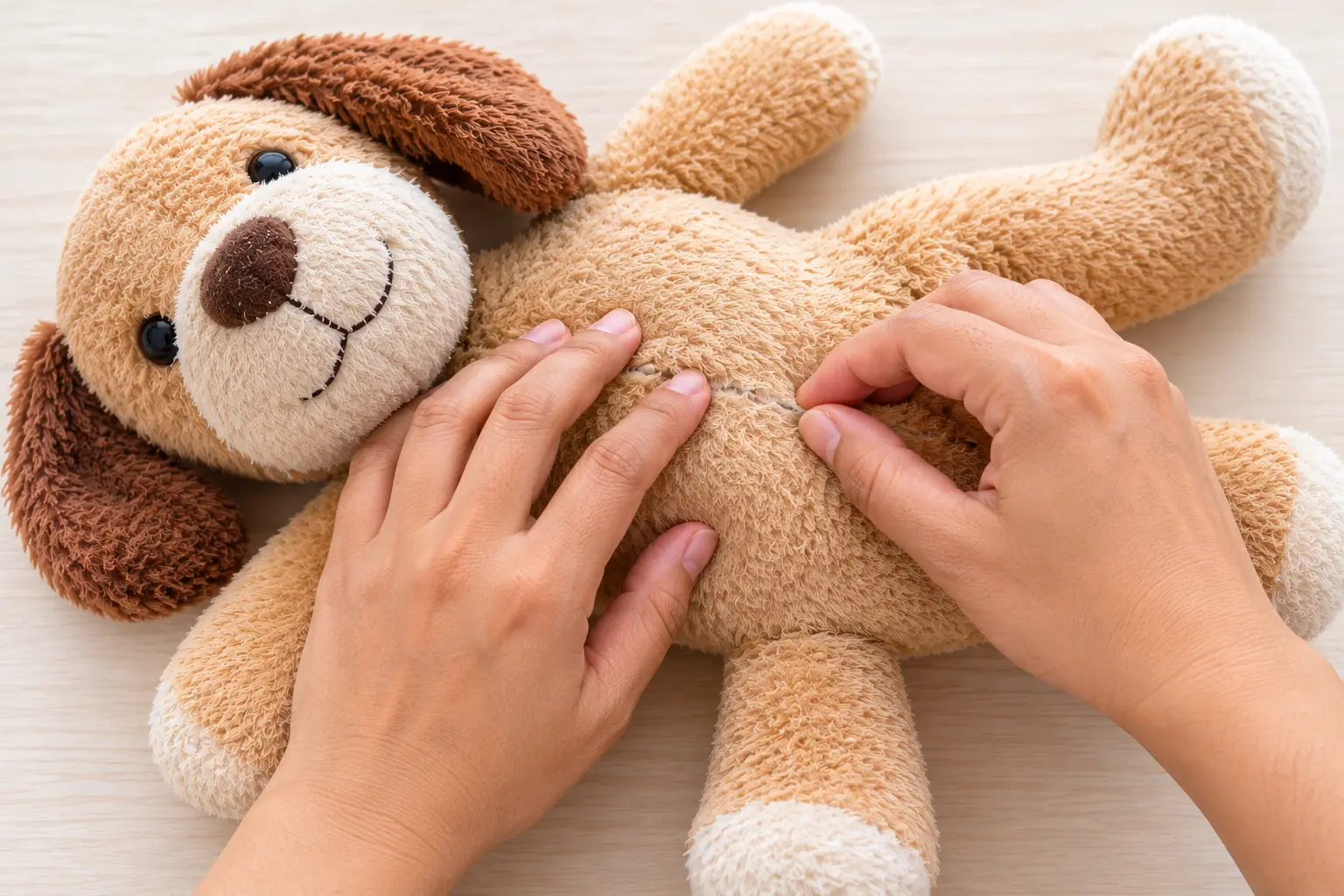
Here’s how to tell if a dog toy is worn out in about a minute:
- Squeeze the toy and run your fingers along every seam.
- Look for stuffing, a squeaker or crinkle paper showing.
- Tug gently on the eyes, ribbons and tags.
- Check for loose or pulled stitching.
- Hold the toy up next to your dog’s mouth to judge its size.
How often should you do it? The sources differ. The Center for Pet Safety advises inspecting toys daily for wear and tear, while Texas A&M says to inspect them regularly without naming an interval. Neither sets a replacement date, so the toy’s condition is what decides.
Offering only one or two toys at a time, rather than a whole basket, makes missing or broken pieces easier to spot, according to Texas A&M. Humane World says a favorite comfort toy can be left out all the time. A toy that’s always within reach should get the check every time you pick it up.
Choosing the Next Plush Toy After You Retire One
Retiring a toy is the safety decision. Choosing the next one is a separate decision, and it starts with how your dog treats soft toys. The American Animal Hospital Association (AAHA) describes three broad patterns: passive chewers may simply carry a favorite plush around, moderate chewers will likely rip soft toys, and aggressive chewers can destroy toys in minutes.
Texas A&M’s advice for a dog who lives to destroy toys is to skip soft, plush and squeaker toys altogether. For that dog, chew toys are the better place to look. For a gentler dog, our guide to plush toys for gentle chewers covers what to look for.
Size matters, too. According to Humane World, dogs who like to shake their toys need ones large enough that they can’t be swallowed by accident. If the toy you’re replacing was a favorite, a similar one is a reasonable swap. Keep the same check in mind for the new one, since soft toys aren’t indestructible.
Here are three plush options from our shop, with the limits each product page lists. All three are plush toys, so the advice above still applies: skip them for a dog who destroys toys.
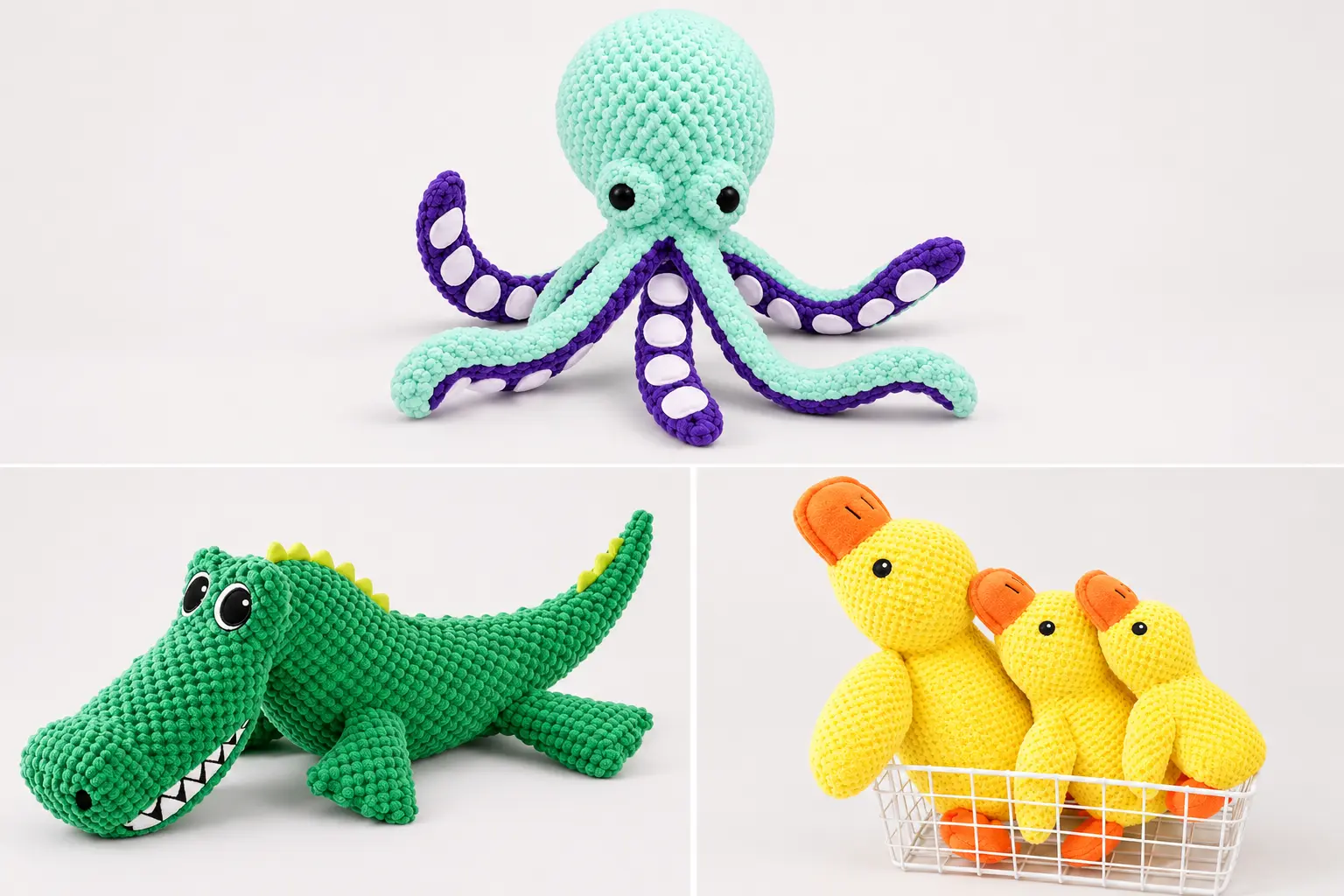
- For a dog who enjoys squeak and crinkle sounds when you’d rather skip loose stuffing: a plush octopus with no traditional stuffing in the head and legs has a squeaker in the head and crinkle paper in the legs. The squeaker and crinkle paper can still be exposed. The page says it’s a plush fabric toy, not an indestructible chew toy, so supervise play and remove it if it’s damaged or develops loose parts.
- For a medium or large dog who tugs or tosses their toys: a double-layer fleece crocodile is designed with large and medium dogs in mind and is about 15 inches long. The page says it isn’t chew-proof: a dog that chews hard enough can break through the fabric and reach the squeaker or filling. Check it regularly for tears and replace it once the seams start to give.
- For replacing a comfort toy: a soft squeaky duck in three sizes lets you match the size to your dog. Its face is embroidered, and its page says it’s a toy, not a treatment. Check the stitching and fabric for holes or fraying, supervise play if your dog chews hard, and set it aside once it looks worn.
A plush toy doesn’t have to look destroyed to be done. If you can see the stuffing, the squeaker or a loose part, or a piece has gone missing, it’s time to replace it. Those are the clearest signs your dog’s plush toy needs replacing, and a minute with the toy in your hands will usually settle it. When you’re ready for the next one, our plush collection has more to choose from, and each product page lists its current specs