
Many plush toy listings carry the same warning: not for aggressive chewers. If you’re shopping for plush dog toys for gentle chewers, that line leaves the real question open. Is your dog actually on the gentle side of it?
Many of our own product pages say the same thing: the toy suits gentle or light chewing and isn’t meant for aggressive or heavy chewers. So this guide starts with the dog, not the toy. You’ll see what “gentle” means, how to read a product page for its limits, and how to match a soft toy to the way your dog plays. It’s written for anyone shopping for plush dog toys for non-aggressive chewers who isn’t sure where their dog falls.
Are plush toys okay for gentle chewers?
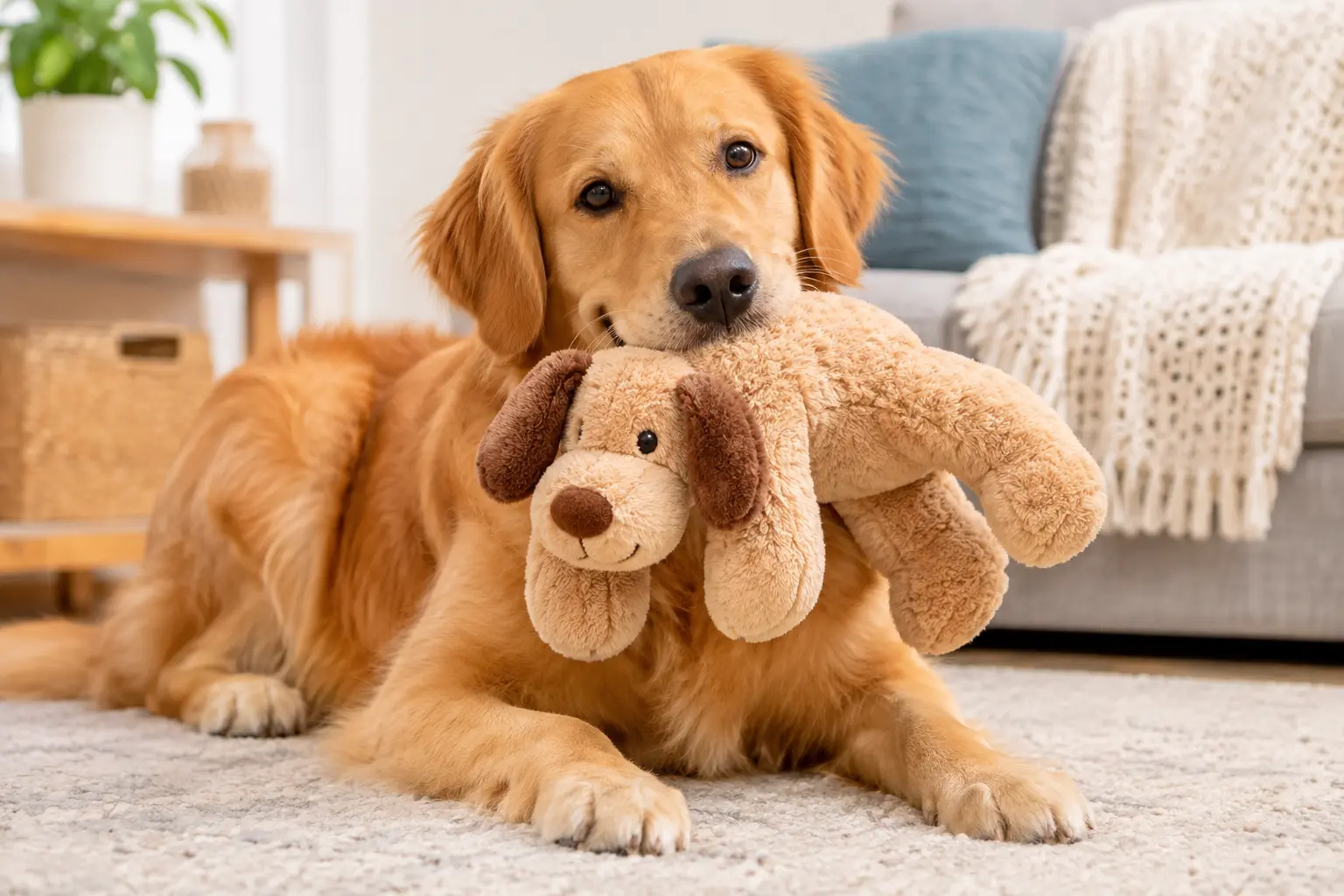
Often, yes. Soft toys are generally a better match for dogs that chew gently than for dogs that shred. AAHA describes passive chewers as gentle on toys, and some carry a favorite plush. They still need checks, because stuffing and squeakers can cause intestinal blockages if swallowed.
Soft toys fit what gentle chewers like to do: carry, cuddle and mouth them. The hazard isn’t the softness. It’s what’s inside and what shows when a seam opens. The Texas A&M veterinary college lists stuffing in soft toys and swallowed squeakers as causes of intestinal obstruction. Humane World for Animals adds that even stuffing sold as safe isn’t truly digestible.
What “gentle,” “light” and “passive” mean
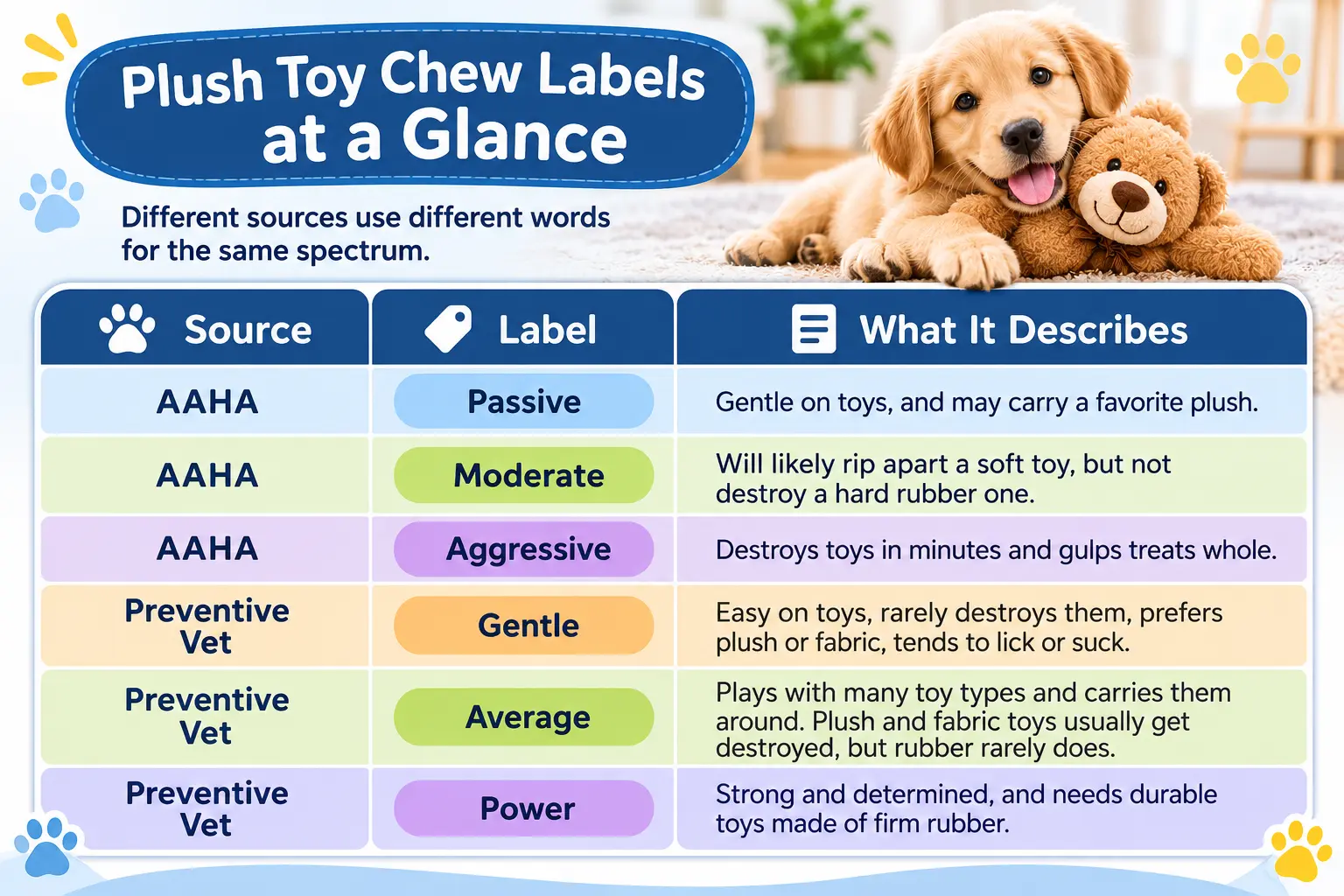
Different sources use different words for the same spectrum. They line up roughly like this, starting with the three chew styles in AAHA’s guide to safe chew toys.
| Source | Label | What it describes |
|---|---|---|
| AAHA | Passive | Gentle on toys, and may carry a favorite plush |
| AAHA | Moderate | Will likely rip apart a soft toy, but not destroy a hard rubber one |
| AAHA | Aggressive | Destroys toys in minutes and gulps treats whole |
| Preventive Vet | Gentle | Easy on toys, rarely destroys them, prefers plush or fabric, tends to lick or suck |
| Preventive Vet | Average | Plays with many toy types and carries them around. Plush and fabric toys usually get destroyed, but rubber rarely does |
| Preventive Vet | Power | Strong and determined, and needs durable toys made of firm rubber |
Shop listings add a third vocabulary, with phrases like “light to moderate” or “not for aggressive chewers.” None of these is a standard scale, so the same words can mean different things from one toy to the next. A label only helps once you know what the page means by it.
In this guide, “gentle chewer” means the passive or gentle group above, the dogs that gentle chewer dog toys are meant for. “Soft mouth” describes the same habit.
How to tell if your dog is a gentle chewer
Watch how your dog treats soft toys during supervised play. AAHA and Preventive Vet describe gentle chewers as easy on toys and rarely destroying them. An ER veterinarian suggests asking whether your dog plays with a toy or tries to eat it. This is an observation guide, not a test.
Gentleness can depend on the toy. Dog owners often describe a dog that is careful with one favorite plush and rough with everything else, so one calm session doesn’t settle it. For a fuller read on chew style, our chew-tier guide for rubber toys walks through an at-home test. It uses a plain chew item rather than a plush toy, and it notes that one test isn’t perfect.
Sudden changes deserve a different response. When a dog’s chewing shifts quickly, a veterinarian can rule out causes such as dental problems or pain.
If your dog is a moderate chewer
AAHA says most dogs are moderate chewers, the kind that will likely rip apart a soft toy but not destroy a hard rubber one. In other words, fewer dogs fit the gentle description than the moderate one.
Advice on moderate chewers and plush isn’t unanimous. Some product listings call plush fine for “light to moderate” chewers. A Texas A&M veterinary clinician advises that a pet who lives to destroy toys should avoid soft, plush and squeaker toys. Both statements can hold, because individual dogs vary a lot in how hard they work on a toy.
This guide doesn’t recommend a specific plush toy for moderate chewers. A dog that opens seams, pulls out filling or hunts for the squeaker is better served by something firmer. Our tougher rubber options for strong chewers are a good place to start.
Choosing plush dog toys for gentle chewers: read the page, not just the label
A product page tells you more than its label does. Three questions get most of the way there.
What chew level does it state, and in whose words? Our corduroy animal toy’s page says it isn’t intended for strong chewers, power breeds or larger dogs. The mini turtle’s page says it fits best with dogs who aren’t aggressive chewers. The eight-leg octopus is described as built for mild to moderate chewing, and the oversized duck’s page calls it a good fit for dogs who aren’t aggressive chewers. Those are four wordings, and they aren’t identical: “mild to moderate” reaches further up the scale than “not an aggressive chewer.” Look for a stated chew level in plain words. “Tough” or “durable” on its own doesn’t say how tough.
How does it fail, and what shows when it does? Product pages name their own weak spots, so read for them. The mini turtle’s page names the seams around the flippers and head as the first spots to go, and says torn fabric can expose the fiberfill and the squeaker. The corduroy animal page says to take the toy away once the fabric splits or the squeaker or stuffing shows. Crinkle plush dog toys add paper inside the shell, which is one more internal part to check. Texas A&M names stuffing and swallowed squeakers as obstruction risks.
What does it say about fill and care? Both vary by product. The calming duck’s page says to hand wash and air dry. The mini turtle’s page has no official washing guidance and suggests spot-cleaning instead of soaking. Plush toys with no stuffing take away one hazard, loose filling, but the squeaker and fabric are still there. Our stuffing-free vs stuffed comparison covers that in full.
Match the toy to how your dog plays
Gentle chewers still play in different ways. Humane World for Animals gives a sizing rule that depends on the habit: carry-sized for dogs who tote a toy around like a companion, and large enough not to be swallowed, yet sturdy enough to survive, for dogs who shake or “kill” theirs. Start there, then check each page’s limits.

Cuddlers and nappers
An oversized duck with no squeaker suits dogs that want something to lean on or haul around quietly. It’s about 19.7 inches long, with embroidered eyes, no zipper and a cover that comes off for washing. The lack of a squeaker also suits homes that prefer quiet. Its page calls it a good fit for dogs who aren’t aggressive chewers, notes it has no reinforced seams, and advises setting it aside once the fabric frays.
A plush duck in three sizes is the squeaky option in this group. It has a pineapple velvet shell, PP cotton filling and a squeaker, in sizes from about 9.8 by 8.6 inches to 17.7 by 14.9 inches. Its page says it isn’t designed for dogs who chew through toys quickly, asks for supervision, and notes it isn’t a treatment for separation anxiety.
Carriers
A lightweight corduroy animal with a squeaker comes in 14 styles that weigh 2.1 to 2.8 ounces. Its page calls it light-duty, says it isn’t intended for strong chewers or larger dogs, and says a gentle medium-sized dog can use it.
Plush dog toys for small dogs get more specific still. Texas A&M notes that a very small amount of stuffing may not matter for a very large dog but can for a small breed. A 4-inch turtle for toy breeds and puppies is made for dogs like Chihuahuas, Pomeranians and Yorkies. Its page rules out larger dogs, who could fit the whole toy in their mouths. Even for a small dog it’s meant for gentle mouthing, and the page suggests pairing it with a dedicated chew toy when teething calls for something tougher.
Tossers and shakers
Shakers need more length and more sturdiness than a carrier. A stuffing-free squeaky octopus is 30 cm (about 11.8 inches) and 60 grams, with a squeaker in the head and crinkle paper in the legs. Squeaky plush dog toys for gentle chewers work best with someone nearby, because Humane World notes that dogs may try to find a squeaker and destroy it. The octopus page says the toy is built for mild to moderate chewing, not for dogs that shred. Because “mild to moderate” reaches into moderate-chewer territory, this one suits dogs on the gentle end of that range. The page also calls the no-stuffing design a safety upgrade, not a guarantee, and says it’s machine washable.
Seekers and sniffers
Some dogs would rather hunt than carry. A snuffle strip shaped like a snail is a 68 cm (about 27-inch) fleece strip with pockets for treats. It rolls into a snail with a hook-and-loop closure and has a squeaker. Snuffle plush dog toys like this one trade chewing for nosework, and the page treats it that way. It calls the toy a sniffing puzzle first, best for dogs who aren’t heavy chewers, used with supervision and not left out as a free-access toy. Plush puzzle dog toys in general work the same way: the point is the search, not the chewing.
Bottom line: check first, then choose
Plush dog toys for gentle chewers work best when the match is checked, not assumed.
- Check the dog. Watch how your dog treats soft toys. When seams, filling or the squeaker become the target, move to a firmer toy.
- Match the toy. Read the page’s stated chew level and size, then pick the play style that fits.
- Keep it supervised. Stay nearby, and keep only a couple of toys out at a time so you can spot missing pieces. Retire a toy when a seam opens or a piece comes loose, rather than patching it. Our guide on how to inspect and retire a plush toy covers what to look for. If part of a toy is swallowed, call your veterinarian promptly instead of waiting for symptoms.
Ready to compare sizes and details? See the full plush range.