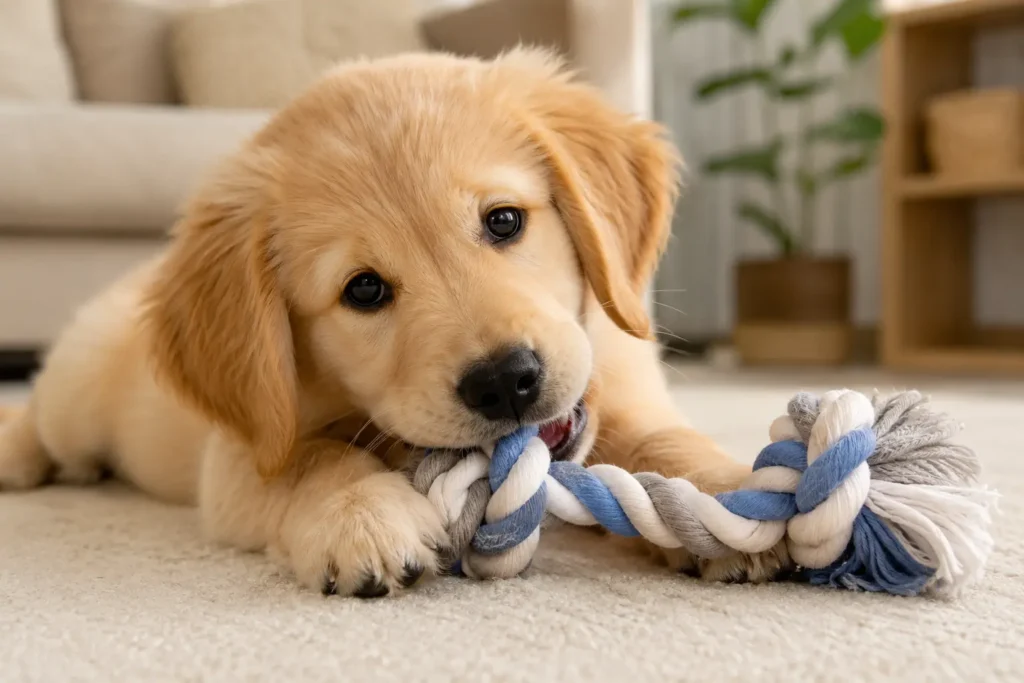

Your dog whines at the door, paces the hallway, or turns a couch cushion into confetti the minute you leave. A soft toy looks like an easy fix, so it’s fair to ask: can plush toys help with separation anxiety in dogs?
The honest answer is “maybe a little, for some dogs.” A plush toy is not a treatment, and we found no study that tested one for this. What the research does support is training, and sometimes medication. This guide covers how to tell anxiety from boredom, what the evidence says, when a stuffed toy should stay out of reach while you’re gone, and how to try one carefully.
Separation Anxiety vs. Boredom in Dogs: Check This First
Before you buy anything, work out what you’re dealing with. Two questions get you most of the way.
Does the behavior happen only, or mainly, when you’re gone? A dog who chews the sofa while you’re home is probably under-exercised or under-stimulated. A dog who destroys things, howls, or soils the house only after you leave is a different case. Guidance from ASPCA, Tufts, and Austin Animal Services all treats distress tied to being alone as the key sign of separation anxiety.
Does your dog look distressed or relaxed when alone? Set up a camera and watch what your dog does after you leave. A bored dog tends to wander, nap, or chew something and settle. An anxious dog may pace, pant, drool, whine, or fixate on the door. Fear Free recommends video for this reason: the footage shows you what happens after you walk out, which you can’t see in person.
Rule out medical causes too, especially if house soiling is part of the picture. Urinary issues and other health problems can look like behavior trouble, so a vet visit is a sensible first step.
This check won’t give you a diagnosis. It tells you which problem you’re trying to solve, and that decides whether a toy is even the right tool.

Can Plush Toys Help With Separation Anxiety? What the Research Shows
Short answer: Possibly as a small comfort for some dogs, but plush toys haven’t been shown to treat separation anxiety. The approaches with real support are behavior modification and, sometimes, medication. Think of a plush toy as an extra, not a plan.
It helps to sort the evidence into three tiers.
Supported. ASPCA guidance points to behavior modification as the core of treatment, with medication helping some dogs. For mild cases, it also suggests a food-stuffed puzzle toy offered only when you leave. That is a food toy, not a plush one.
Suggestive. A 2016 study by Shin and Shin in the Journal of Veterinary Science looked at 28 small-breed dogs with owner-reported separation signs during a 20-minute lab separation. Dogs given the owner’s worn T-shirt or a recording of the owner’s voice showed a smaller early rise in saliva cortisol than control dogs. Absolute cortisol levels did not differ between groups at each time point, the sample was small, and no plush toy was involved. A Nashville animal-services handout also notes that anxious dogs often seek out and chew items that smell like their owner. That is an observation, not a trial.
Not shown. We found no study showing that a plush toy, scented or not, reduces separation anxiety in dogs.
So the idea has a plausible thread: your scent and voice may be comforting. It hasn’t been tested with plush toys, so this guide treats them cautiously.

Can You Leave a Stuffed Animal With Your Dog When You Leave?
Short answer: For most plush toys, treat them as something for when you’re home. A dog can chew, shred, or swallow parts of a toy when nobody is watching, and some anxious dogs chew on objects when left alone. For your departure, a food puzzle toy has better support, at least for mild cases.
Cornell’s veterinary guidance lists toys among the common foreign bodies dogs swallow, and says most gastrointestinal foreign body obstructions require surgery. If your dog has already swallowed stuffing or a squeaker, our guide to plush toy safety walks through what to do.
There is also an awkward overlap. Destructive chewing is a recognized sign of separation anxiety, so the dog who most needs comfort may be the one most likely to rip a plush toy open.
Our own product pages say much the same. Several of our plush product pages ask for supervised play, and some say not to leave the toy with your dog alone. The Stuffing-Free Duck page says it isn’t for unattended or crate use. The Squeaky Plush Dog Toy and Squeaky Carrot FAQs both answer “No” when asked about leaving the toy with a dog alone. The Plush Dinosaur page asks for supervised play, not unattended stretches.

Stuffing-free doesn’t change that. You can see how stuffing-free toys compare in our separate guide.
ASPCA’s approach for departures is a food-stuffed puzzle toy that takes your dog at least 20 to 30 minutes to finish, offered only when you leave and put away when you return.
Let the camera decide. If your dog tears fabric, or the footage shows destruction while alone, plush stays a when-you’re-home toy.
Stuffed Animals for Dogs With Separation Anxiety: Which Dogs They Suit
A plush toy is a reasonable thing to try for some dogs and the wrong tool for others.
| Your dog | What it suggests |
|---|---|
| Carries toys gently, shows mild signs, and you’re home | Reasonable to try, with supervision |
| Shreds soft toys | Wrong tool; choose durable rubber options for hard chewers |
| Gets more agitated when the plush appears | Remove it |
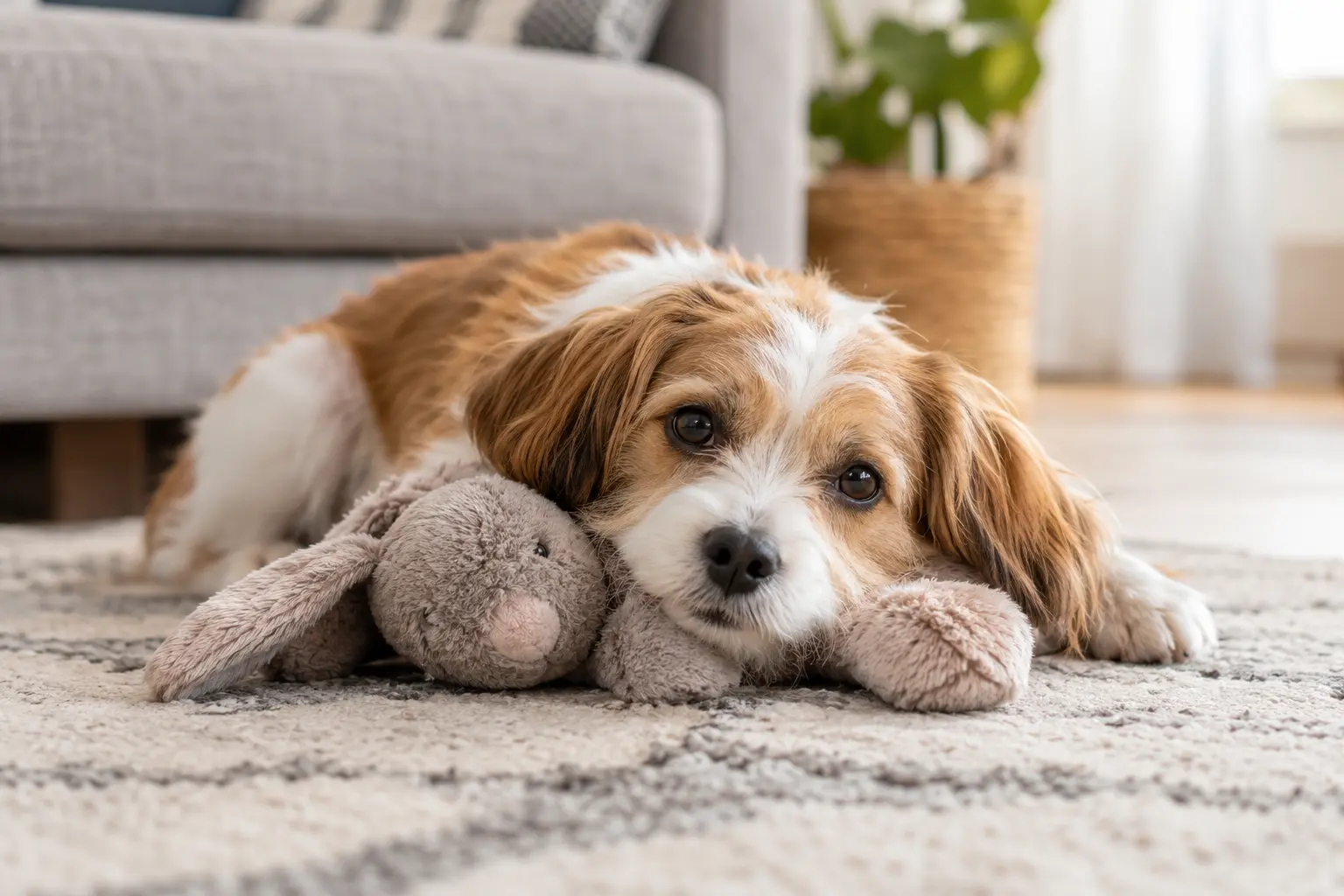
Puppies. Owners often ask about a plush toy for a puppy who cries at night. Some owners report that a soft toy nearby helps, but we found no solid research on it, and puppies chew, so keep it supervised.
Two plush examples, with their limits.
The oversized plush duck measures about 19.7 in (50 cm, give or take 1 to 2 cm). It’s fleece with PP cotton fill, has no squeaker, and has a zipperless detachable cover. The page recommends it for non-aggressive chewers, asks you to supervise and remove it if damaged, and says to wash the cover gently and air dry it fully. It also says plainly that it is not a substitute for training or veterinary guidance for ongoing anxiety.


A 10 cm plush turtle is about 4 in (give or take 2 to 3 cm) and is meant for puppies and toy breeds only. A bigger dog can take it whole, which is a choking risk. The seams around the flippers and head loosen first. There is no official washing guidance, so avoid soaking and spot-clean. Supervise it.
Introducing a Comfort Plush at Home: What to Watch For
When your dog suits the profile above, introduce the toy while you’re home and things are calm. A relaxed moment is a better time than the minute you grab your keys.
Then watch how your dog responds. Signs of stress include pacing, panting, trembling, yawning, and drooling. If those signs climb, put the toy away. A comfort item that makes your dog more worked up is not doing its job.
We found no research behind a plush-specific protocol, so treat this as a sensible approach, not a method. Stay nearby while your dog gets used to it, and keep the first sessions short.
For dogs who like to sniff and forage, a snuffle toy can be a gentler option. Our fleece snuffle toy is about 68 cm (27 in) unrolled, weighs 85 g, is polar fleece with a squeaker, and is washable. It’s for supervised puzzle time only, not a free-access toy, and it isn’t for heavy chewers.

When a Plush Toy Isn’t Enough
Moderate to severe separation anxiety needs more than a toy. ASPCA describes a desensitization and counterconditioning program, with many very short absences that you lengthen slowly over weeks, and says it calls for the guidance of a trained, experienced professional. Medication can also be very helpful, especially in severe cases, but only through your veterinarian or a veterinary behaviorist.
Fear Free’s guidance on separation anxiety describes a plan with several parts: shaping relaxed, independent behavior, building a calm and consistent departure routine, and changing what your departure cues mean to your dog. It calls behavioral therapy crucial to long-term success.
Start with your vet to rule out medical causes. Avoid punishment or scolding. ASPCA says anxious behavior is a distress response and that punishing it can make the problem much worse.
Get professional help sooner when your dog is hurting itself or escaping.
The Bottom Line
So, can plush toys help with separation anxiety in dogs? Sometimes, as a small comfort when you’re home, for a dog who handles soft toys gently. They’re not a treatment, we found no research on them for this, and most should not be left with your dog alone. To try one, start with softer, gentle-chewer options and let your dog’s behavior tell you whether it helps.
Browse our plush dog toys and check each product page for size, supervision notes, and care instructions.
Frequently Asked Questions
Do heartbeat toys really help anxious dogs?
Evidence is thin. A veterinary behaviorist quoted by Vetstreet says no scientific studies show these toys reduce fear or anxiety in dogs. A vet-reviewed Dogster article says they may help some puppies adjust, but not every dog responds, and supervision is advised. Severe anxiety needs more than a toy.
Are enrichment toys better than plush toys for anxiety?
They do different jobs. Only food puzzle toys have guidance behind them, and that covers mild cases. A plush toy offers softness and your scent but is untested. Neither replaces training, so match the toy to what your camera shows.
What if my dog ignores toys when I leave?
That can be informative. ASPCA says highly anxious dogs usually won’t eat when alone, and Fear Free says a dog refusing food enrichment during departures may be too stressed to enjoy it. Note what you see on camera.
Could my dog’s chewing be something other than separation anxiety?
Yes. ASPCA lists destruction by young, still-developing dogs as a separate cause to rule out. Chewing that also happens while you’re home points away from anxiety. A vet visit can rule out medical causes.
Do medications help dogs with separation anxiety?
They can. ASPCA says medication can be very helpful, especially in severe cases. Fear Free notes fluoxetine and clomipramine are licensed for dogs with separation anxiety. Medication works alongside behavior therapy, and only your vet or a veterinary behaviorist can decide what suits your dog.